The Monster We Built: Charles Manson, the State, and the Satanic Panic That Never Was
Evidence-first pattern recognition. Sourced to reputable reporting.
Discusses institutional child abuse, sexual abuse, violence, and murder.
If this content may be triggering, skip to recovery resources →
The Pattern
Charles Manson did not come from nowhere. He came from us.
The popular memory of Charles Manson is convenient. A wild-eyed demon crawled out of the California desert, whispered to hippies, and broke America’s innocence in the summer of 1969. This narrative requires Manson to be an anomaly, a rupture, something that could not be explained by the society that produced him. It requires, in short, that we look away from the machinery.
The record does not support looking away.
What the record supports is this: Charles Milles Manson was raised almost entirely by American government institutions, shaped by American religious culture, surveilled and managed by American law enforcement for two decades before the Tate-LaBianca murders, and then elevated into a mythological figure by the same institutions that failed him. He was not an outsider who attacked the system. He was the system’s most famous graduate.
I. The Institutional Child
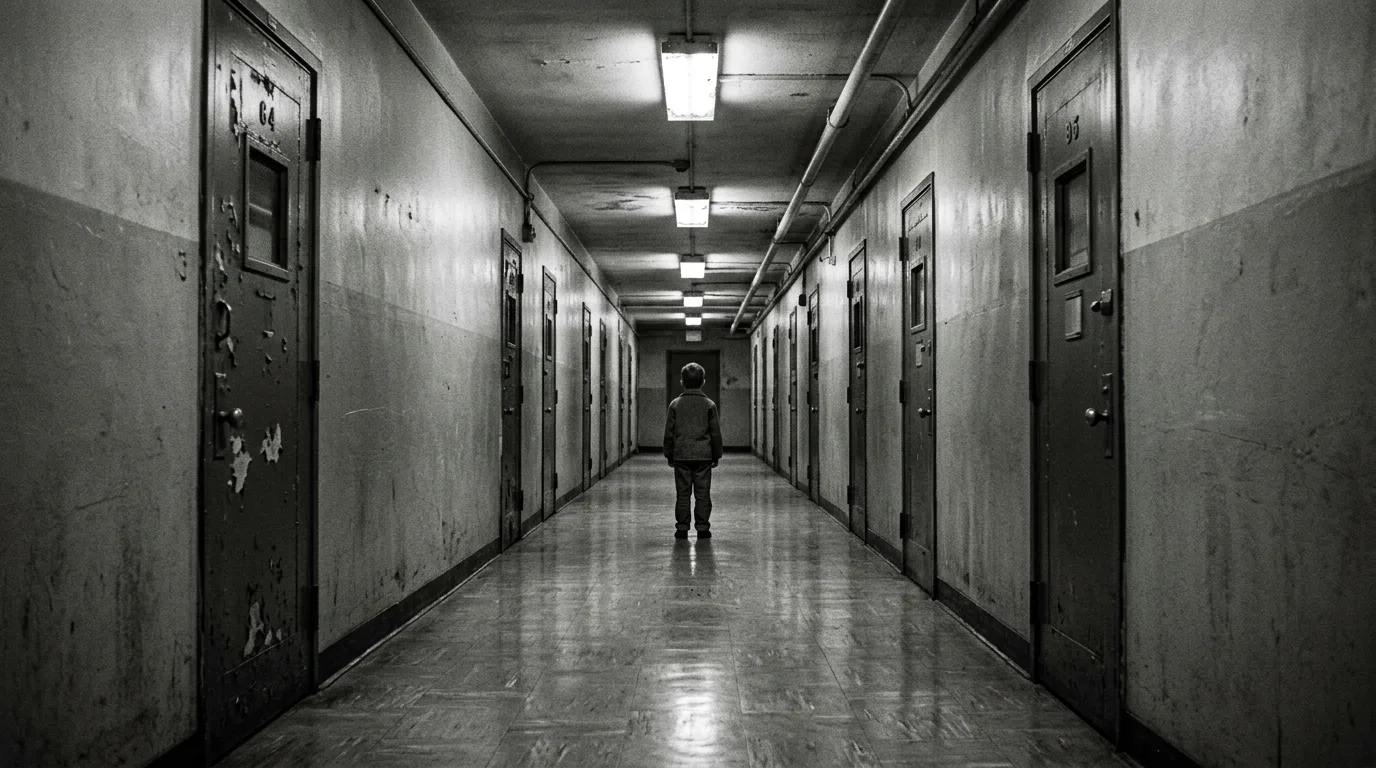
Manson’s mother, Kathleen Maddox, was sixteen when he was born in Cincinnati in 1934. She was an alcoholic who reportedly traded him for a pitcher of beer. Think about that. A child, offered as payment for a drink. No one intervened. No institution flagged it. He was placed with an aunt and uncle, then shuffled through a series of relatives, foster homes, and reform schools like a problem no one wanted to solve.
By the age of thirteen, Manson had been committed to the Gibault School for Boys in Terre Haute, Indiana, a Catholic institution. He was a child. He ran away, because children run from cages. He was sent to the Indiana Boys School in Plainfield, a state reformatory where former inmates later described systematic beatings, solitary confinement, and sexual abuse by staff. He ran away again. He was sent to the National Training School for Boys in Washington, D.C., a federal institution. He ran away again. Each time, the system’s answer was the same: a harder cage, a longer sentence, a deeper lesson that no one was coming to help.
Between 1951 and 1967, Manson spent the majority of his adult life in federal prisons: Terminal Island, McNeil Island, and others. He entered prison as a small-time car thief and pimp, a nobody the state had been processing since childhood. He left, in March 1967, as something else entirely. Prison had been his university. Sixteen years of it. He learned guitar, manipulation, and the specific charisma of a man who has nothing to lose because nothing was ever given to him. He learned that institutions do not rehabilitate. They incubate. They take a wounded child and return a weapon, and then act surprised when the weapon fires.
This is the stated conclusion of decades of criminological research. The American prison system of the mid-twentieth century was designed to warehouse, punish, and, in the case of federal institutions, to manage populations the broader economy had no use for — not to produce functional citizens. Manson was one of those populations. He was raised by the state, educated by the state, and released by the state into the exact cultural moment, the Haight-Ashbury counterculture, where a skilled manipulator with a grudge could find an audience.
The question is not whether the system failed Charles Manson. The question is whether it was ever designed to do anything else. The question is what we owe the thousands of children still in those corridors today, the ones no one will write books about, the ones who will not become famous monsters, only quiet ones.
II. The Machinery Was Running
Manson’s institutional years, 1934 through 1967, overlap precisely with the most aggressive period of domestic operations conducted by American intelligence and law enforcement agencies. The overlap is context, not causation, but it is context that the “lone madman” narrative requires us to ignore.
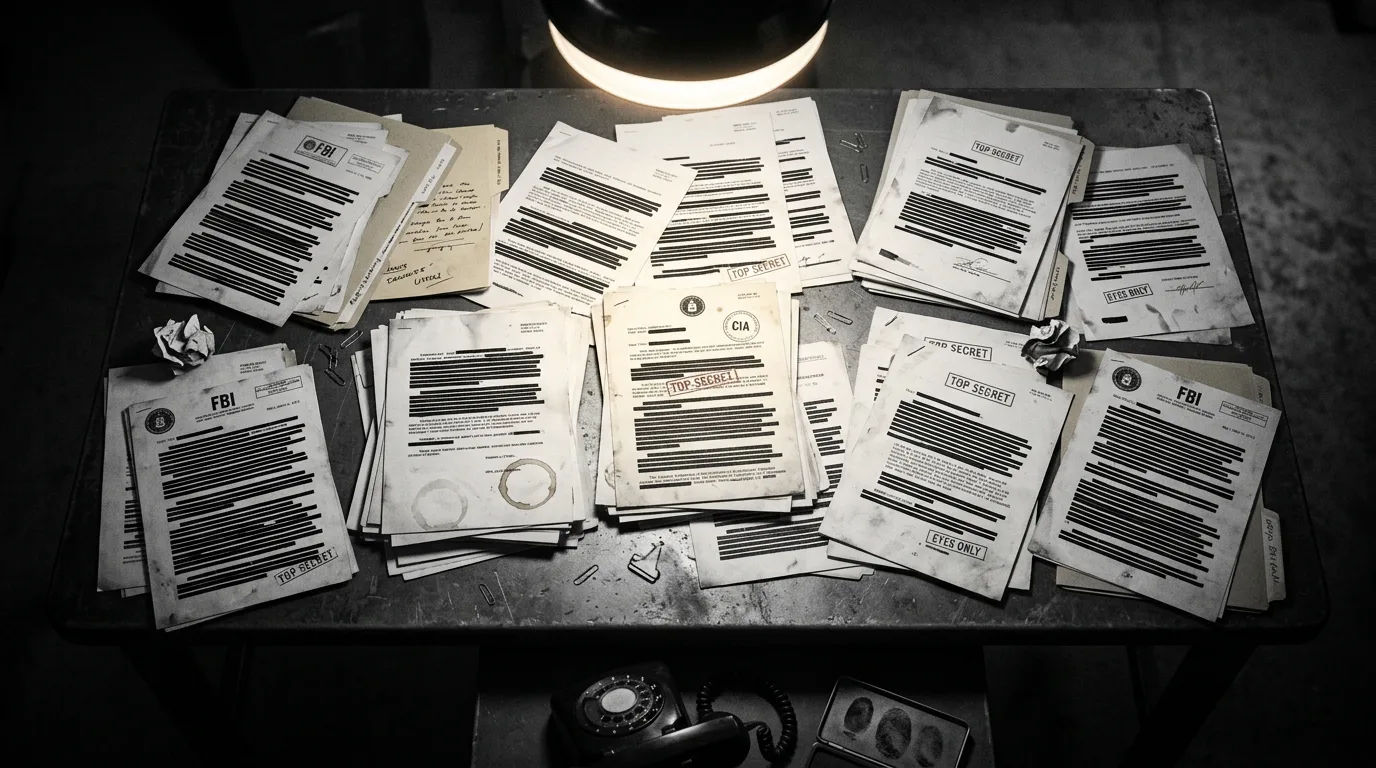
COINTELPRO. The FBI’s Counter Intelligence Program ran from 1956 to 1971, though its operations against domestic groups began earlier and continued in modified form afterward. Its stated purpose was to surveil, infiltrate, discredit, and disrupt organizations the Bureau deemed subversive. Its actual targets included the Communist Party, the Socialist Workers Party, the Ku Klux Klan, the Nation of Islam, the Black Panther Party, and the broader New Left. COINTELPRO did not merely observe. It forged correspondence to create internal conflicts, planted false media stories, instigated violence between rival groups, and conducted psychological operations against American citizens. The program was exposed in 1971 when a group calling itself the Citizens’ Commission to Investigate the FBI burglarized an FBI field office in Media, Pennsylvania, and released thousands of documents. Senator Frank Church’s committee confirmed the program’s existence and scope in 1975.
MK-Ultra. The CIA’s mind-control research program ran from 1953 to 1973. It involved the administration of LSD, hypnosis, sensory deprivation, electroshock, and other techniques to unwitting human subjects, including prisoners, psychiatric patients, and college students. The program was partially exposed by the Church Committee in 1975 and further documented through a 1977 FOIA request that recovered approximately 20,000 surviving documents. Director Richard Helms had ordered the destruction of most MK-Ultra files in 1973, so the full scope of the program may never be known.
The broader pattern. These programs were funded through congressional appropriations, authorized at senior levels, and conducted by career professionals within the federal government — hardly rogue operations. They reflected an institutional consensus, shared across administrations from Eisenhower through Nixon, that domestic dissent was a national security threat to be managed by any means necessary.
Manson was not a COINTELPRO target. There is no documented evidence that the CIA dosed him with LSD under MK-Ultra. Anyone who claims otherwise is speculating, and speculation should be labeled as such. But the argument that Manson was “a product of the government” does not require a direct operational link. It requires only that we acknowledge what the government was actually doing during the years it was raising him: running a parallel infrastructure of surveillance, psychological manipulation, and institutional violence against its own population, while the prison and reform-school system that housed Manson operated on the same logic of control without accountability.
The state did not need to program Charles Manson. It had already built the laboratory. He grew up inside it. Every reform school hallway was an experiment in what a human being becomes when you remove love and add only control. The result was not a mystery. It was a curriculum.
III. The Religious Industrial Complex
If the state provided the institutional architecture, American religious culture provided the narrative software.
Manson grew up in the Bible Belt and the Rust Belt, steeped in the same evangelical Protestant culture that saturated mid-century American life. The Gibault School where he was first committed was a Catholic institution. The reform schools and prisons that followed were saturated with compulsory religious instruction. The broader culture told him, as it told every child in his cohort, that America was a Christian nation, that suffering was redemptive, that authority was divinely ordained, and that the end times were approaching.
Manson internalized this framework and then weaponized it. The Family was not a secular commune. It was a cult in the strictest theological sense: a charismatic leader who positioned himself as a Christ figure, who preached an apocalyptic race war he called “Helter Skelter” (borrowed from the Beatles, but structured like the Book of Revelation), and who demanded absolute obedience as the price of salvation. Manson did not invent this template. He found it in every church, every reform school chapel, and every prison Bible study he had ever attended. He simply removed the institutional intermediaries and installed himself at the top.
This is the uncomfortable part of the Manson story that the “demon hippie” narrative exists to suppress: Manson’s theology was not alien to American Christianity. It was American Christianity with the denominational branding stripped away. The apocalypticism, the authoritarian leadership structure, the demand for total surrender, the framing of violence as divine instrument, these were not Manson’s innovations. They were the dominant features of the religious landscape he was raised in.
By the late 1960s, this landscape was industrializing. Billy Graham’s crusades had turned evangelical Christianity into a mass-media enterprise. Pat Robertson was building the Christian Broadcasting Network. The infrastructure that would become the Moral Majority and the Religious Right was being laid. The “Religious Industrial Complex” describes the economic and political structure that emerged when American churches began operating as media companies, political action committees, and real estate empires simultaneously. This complex needed enemies to justify its existence and its fundraising. It would find them.
IV. The Panic That Was Never About Satan
The Satanic Panic of the 1980s and early 1990s is now well-documented as a moral panic, a period in which thousands of Americans, including law enforcement officers, prosecutors, therapists, and clergy, became convinced that organized networks of Satanists were infiltrating communities, abusing children in ritualistic ceremonies, and conducting human sacrifice on a massive scale.
The evidence for these claims was, and remains, essentially zero. Not thin. Not contested. Zero.
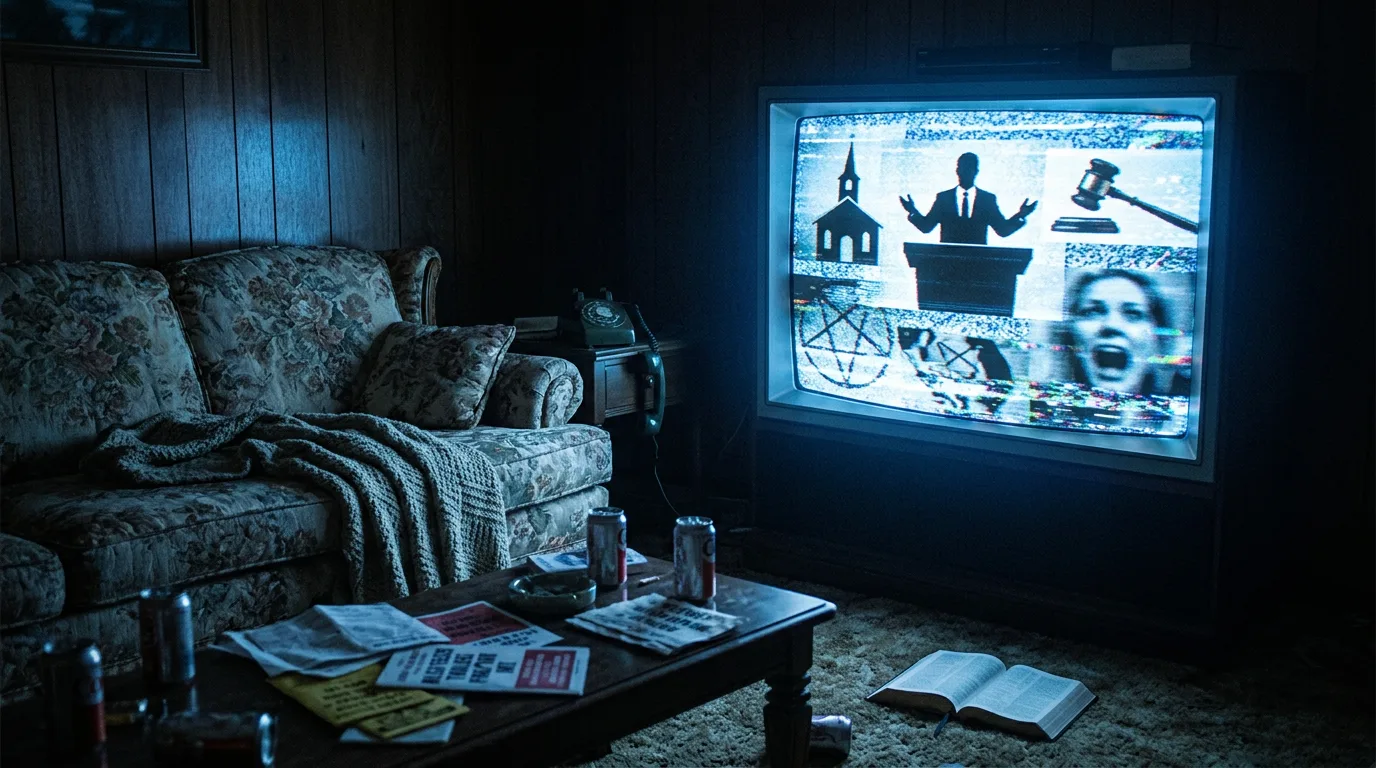
The FBI’s own investigation, led by agent Kenneth Lanning, concluded in 1992 that there was no evidence of organized Satanic criminal activity. The McMartin Preschool trial, the longest and most expensive criminal trial in American history at that point, ended in 1990 with no convictions after seven years and $15 million in prosecution costs. The Kern County cases, the Fells Acres case, the West Memphis Three, the Satanic ritual abuse allegations that destroyed hundreds of lives and families, all collapsed under scrutiny or were later recognized as products of coercive interrogation, recovered-memory therapy, and mass hysteria.
But the panic was functional, not irrational.
Consider what the Satanic Panic accomplished for the institutions that promoted it:
It externalized evil. If child abuse was the work of hidden Satanic networks, then it was not the work of fathers, uncles, coaches, priests, and pastors. Let that land. The panic redirected attention away from the most statistically common perpetrators of child sexual abuse, who are family members and trusted community figures, and toward a fantastical external enemy. The Catholic Church’s abuse crisis, which would later be documented as involving thousands of priests and tens of thousands of victims, was occurring during the exact period that evangelical and Catholic communities were most consumed by the specter of Satanic strangers. The panic was, in effect, a misdirection so effective that its architects may not have consciously planned it. The children were being abused in the sanctuary, and the congregation was looking for the devil in the daycare.
It justified institutional expansion. The panic generated demand for more police, more prosecutors, more therapists, more clergy, more legislation, more surveillance. Every institution that promoted the panic grew in budget, authority, and cultural legitimacy as a result. The National Center for Missing and Exploited Children was founded in 1984. Mandatory reporting laws expanded. These institutions do real and necessary work. They were also built, in part, on a foundation of manufactured fear. The AMBER Alert system, created in 1996 after the abduction of Amber Hagerman, was a later and more legitimately grounded development — but it inherited the institutional infrastructure the panic had built.
It consolidated the Religious Right. The Satanic Panic was inseparable from the political mobilization of evangelical Christianity in the 1980s. The same networks that promoted the panic — Christian bookstores, church newsletters, televangelist broadcasts, conference circuits — were the networks that built the Moral Majority, the Christian Coalition, and the political infrastructure that delivered the Reagan presidency and reshaped the Republican Party. The panic was not a side effect of this mobilization. It was the mobilization’s emotional engine. You cannot build a political movement around the defense of traditional values without first demonstrating that those values are under siege by an existential enemy. Satan was the most convenient enemy available. He had the advantage of being unverifiable.
It pathologized dissent. The counterculture of the 1960s and 1970s had challenged the authority of churches, governments, and traditional institutions. The Satanic Panic recast that challenge as literally demonic. Heavy metal music, role-playing games, alternative spirituality, non-Christian religious practice, and general youthful nonconformity were all reframed as potential gateways to Satanic influence. The message was clear: the system is not failing you. You are being attacked by evil. Come back inside. Obey. Consume. Do not question.
The most parsimonious reading of the Satanic Panic is that it was not a failure of the churches and the government but a success, the system’s immune response to the threat of accountability. When the institutions that were supposed to protect children were the ones abusing them, when the government that was supposed to defend civil liberties was the one violating them, when the churches that were supposed to provide moral leadership were the ones covering for predators, the system did not correct itself. It generated a new enemy, pointed the population toward it, and dared anyone to look in any other direction. And it worked. God help us, it worked. For twenty years, no one looked at the priests. No one looked at the pastors. No one looked at the coaches and the uncles and the deacons. They were too busy hunting a dragon that did not exist while the real predators sat in the pews and smiled.
V. The Spiral
The pattern does not end in the 1990s. It recurs.
The “War on Terror” after September 11, 2001, followed the same structure: an external existential threat used to justify the expansion of surveillance, detention, and military authority, while domestic institutional failures — the financialization of the economy, the collapse of the social safety net, the ongoing abuse crises in religious institutions — continued without meaningful accountability.
The QAnon phenomenon of the late 2010s and 2020s is the Satanic Panic’s direct descendant, updated for the social media era. Its core narrative, that a hidden cabal of Satanic pedophiles controls the government and must be overthrown by a messianic leader, is structurally identical to the Satanic ritual abuse narrative of the 1980s. The institutions that failed to address the real sources of public anguish, economic precarity, institutional corruption, the collapse of community, generated a new mythological enemy because addressing the real one would require them to dismantle themselves.
The spiral tightens. Each cycle of manufactured panic further erodes trust in institutions, which generates more anxiety, which generates demand for more panic, which further erodes trust. The system does not spin out because it is failing. It spins out because failure is the only mode of operation it has left. Correction would require accountability. Accountability would require the institutions to prosecute themselves. They will not. So they generate another Satan, another Manson, another external monster, and the cycle continues. And each time, the monster gets stranger, the panic gets louder, and the real rot gets deeper. The spiral is not a malfunction. It is the design.
The mechanism that makes the spiral possible is neurological as much as political. The dissociative states produced by engineered worship environments are the precondition for the violence that then justifies the next cycle of panic. Mass Hysteria Is Not a Metaphor documents how the trance state, the theology, and the government profit form a closed loop.
VI. What Manson Actually Tells Us
Charles Manson was not a product of Satan. He was a product of the Gibault School for Boys, the Indiana Boys School, the National Training School for Boys, the federal prison system, the American foster care system, the American evangelical church, and the American cultural consensus that all of these institutions were benevolent and that their failures were individual rather than structural.
He was not an anomaly. He was a predictable output.
The system that produced him then put him on trial and executed the performance of justice, while the institutions that built him continued operating without interruption. The FBI’s COINTELPRO was officially discontinued in 1971. Its techniques were absorbed into standard law enforcement practice. The CIA’s MK-Ultra was officially terminated in 1973. Most of its files were destroyed. The religious institutions that provided the theological framework Manson weaponized grew more powerful, more wealthy, and more politically influential in the decades that followed.
The Satanic Panic reads as the system’s confession, disguised as an accusation. When the churches screamed about Satan in the daycare centers and the heavy metal concerts and the Halloween costumes, they were screaming about themselves. They were projecting their own institutional rot onto a phantom enemy because the alternative — looking at what they had actually done, what they were actually doing, to children, to congregants, to citizens, to the social fabric — was more than the system could tolerate acknowledging.
Charles Manson is dead. He died in prison in 2017, at the age of eighty-three, having spent the majority of his life inside American institutions. He was five feet two. He weighed 138 pounds. The most famous monster in American history was a small, unloved child whom the state processed for seven decades and then blamed for its own reflection. The institutions that raised him are still operating. The panic they generated to avoid examining themselves has mutated but not ended. The spiral continues.
The monster was never the man. The monster was the factory. And the factory is still open. And the children are still inside.
Patterns in this piece
Crisis cycling
You called it a rough patch. You did not notice that the rough patches arrived on a rhythm, and that the rescue always came from the same hand that lit the fuse.
Authority laundering
You stopped asking for the evidence because the phrase sounded settled. 'Experts agree' was the whole argument. The authority was borrowed, never shown.
Synthetic consensus
Everyone's saying it. Everyone is one farm.
Blame concentration
One person took the fall. The system stayed standing. The scapegoat was load-bearing.
Sources
- Church Committee, Book II: Intelligence Activities and the Rights of Americans (1976)
- Kenneth Lanning, Investigator's Guide to Allegations of Ritual Child Abuse (FBI, 1992)
- CIA MK-Ultra FOIA Release (1977)
- Jeff Guinn, Manson: The Life and Times of Charles Manson (2013)
- Ed Sanders, The Family (1971, revised 2002)
- Debbie Nathan and Michael Snedeker, Satan's Silence (1995)
- Richard Beck, We Believe the Children (2015)
- Senate Select Committee on Intelligence, Project MKULTRA Joint Hearing (1977)
Tags
Related Essays
Mass Hysteria Is Not a Metaphor: Religious Psychosis and the Violence It Enables
Multiple sources (16)
The Sascha Riley Tapes: What the Record Actually Shows
Multiple sources (8)

The Exemption Is the Loophole
Multiple sources (13)