Mass Hysteria Is Not a Metaphor: Religious Psychosis and the Violence It Enables
Evidence-first pattern recognition. Sourced to reputable reporting.
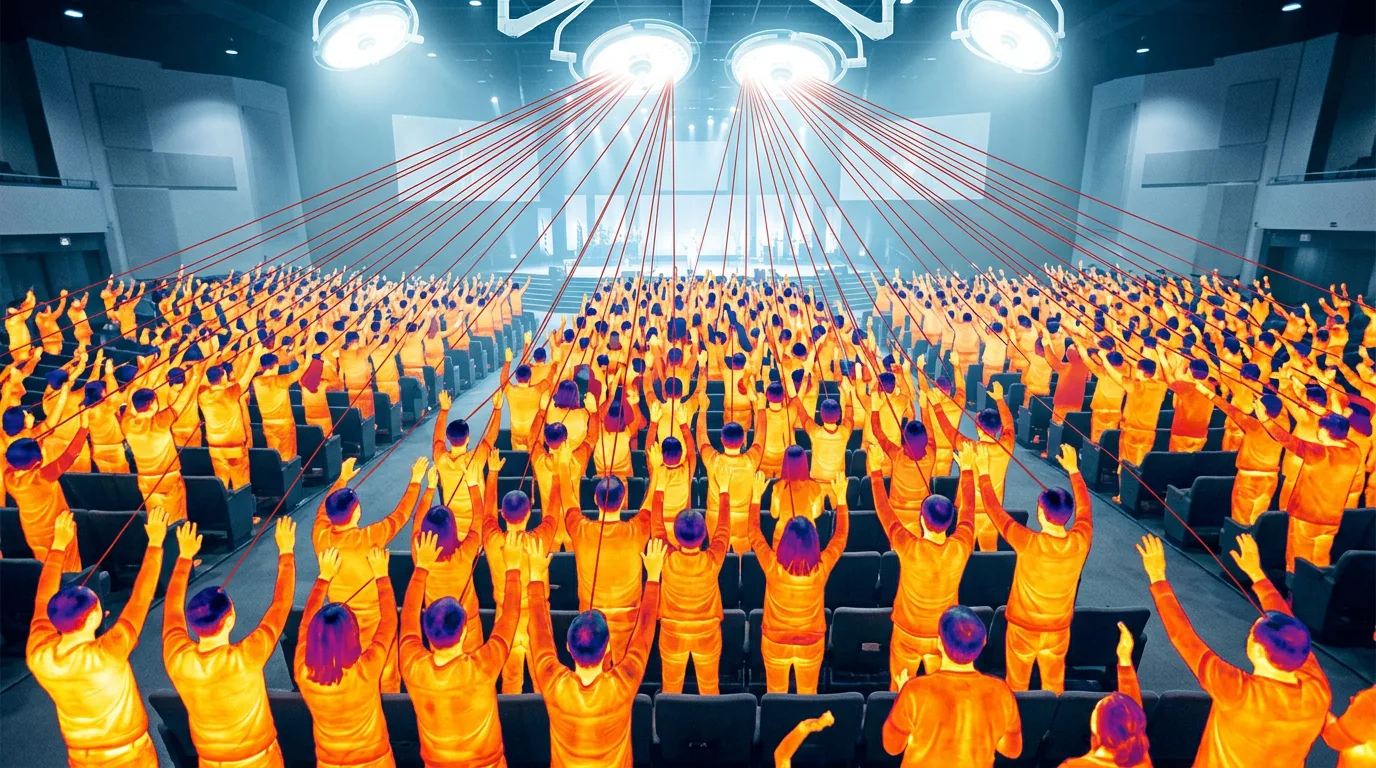

Discusses mass violence, murder, child abuse, suicide, and government surveillance programs.
If this content may be triggering, skip to recovery resources →
The Pattern
It is 11 PM on a Wednesday. The music has been playing for ninety minutes. The person next to you is on the floor, shaking, speaking in a language they do not know. The pastor says “let go” and the room says “let go” and your breathing has changed and you did not decide to change it. Your critical voice, the one that notices things, has gone very quiet. You feel enormous. You feel held. You feel, for the first time in weeks, like you are not alone.
None of this is accidental.
The state you are in has a name. It is not “the Spirit.” It is dissociation, and it is measurable, and it is the product of an engineered environment. The government knows this. The government has known for fifty years. And the government has built, on the back of your Wednesday night, a machine that converts your transcendence into policy, your policy into law, and your law into a body count.
This is not an argument against God. It is an argument against the machine that uses God as a delivery system, and against the government that feeds on the output.
I. The clinical reality
The term “religious psychosis” is not a slur. It describes a documented cluster of symptoms: dissociative trance states, auditory and visual hallucinations interpreted as divine communication, loss of reality testing, depersonalization, and the suspension of moral reasoning under the authority of a perceived supernatural command. The DSM-5 lists “Religious or Spiritual Problem” (V62.89) as a non-disorder V-code for spiritual concerns that cause distress but are not attributable to a mental disorder. The symptoms described above (hallucinations, loss of reality testing, depersonalization) overlap with brief psychotic disorder, dissociative identity presentations, and shared psychotic disorder (folie à deux, folie à plusieurs).
The critical distinction is this: in a clinical setting, these symptoms are treated as pathology. In a religious setting, the same symptoms are treated as evidence of the Holy Spirit. A person who hears voices in a hospital is medicated. A person who hears voices in a charismatic church is promoted to prophet. The neural correlates are similar enough that the social framing, not the neurology, determines whether the person receives treatment or an audience.
Research on glossolalia (speaking in tongues) using SPECT imaging has documented measurable alterations in frontal lobe activity during the practice. Newberg et al. (2006), in a SPECT study of glossolalia, found decreased activity in the frontal lobes and anterior cingulate during the practice. The orientation association area finding, localized to the posterior superior parietal lobule, comes from separate meditation and prayer studies with Tibetan Buddhist meditators and Franciscan nuns, reported in Newberg’s Why God Won’t Go Away (2001). The prefrontal cortex is heavily involved in critical thinking, impulse control, and moral reasoning. Newberg hypothesizes that the posterior superior parietal lobule helps maintain the self-other boundary, and that reduced activity there contributes to the sense of merging with the infinite. When both regions go quiet, on his reading, the person experiences ego dissolution and a profound inability to distinguish internal experience from external reality.
This is not a bug. In the context of a worship service designed to produce this state, it is the product. The AI age has added a new vector for the same dissociative loop, documented in Religious Psychosis in the AI Age: chatbots now intensify the trance by providing unlimited confirmation of the voices.
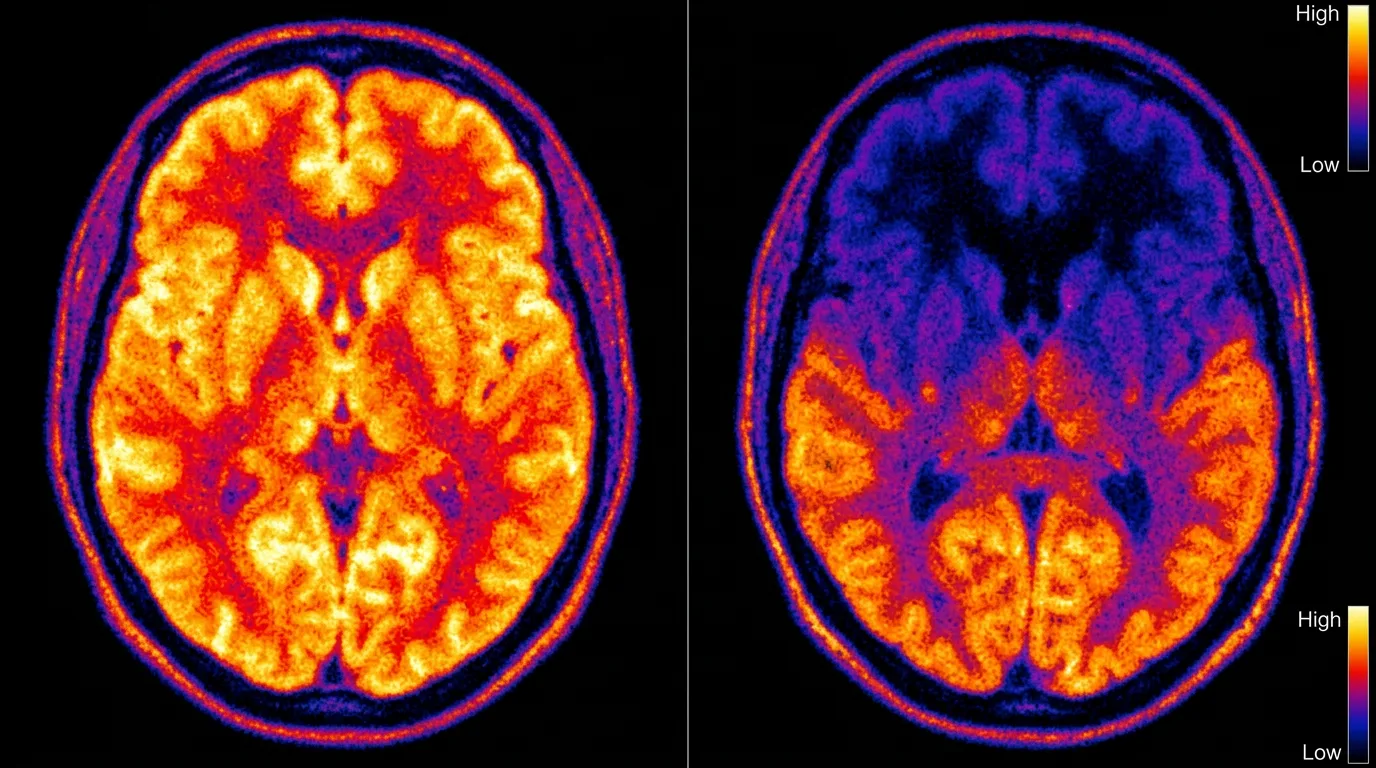
What the scan shows: the frontal lobes during glossolalia. The region that says “wait, maybe not” goes dark. The person does not experience this as loss. They experience it as God.
II. The induction machine
Conservative Christian worship, particularly in charismatic, Pentecostal, and Word of Faith traditions, is an engineered dissociative environment. It is an observation about design, not a conspiracy claim.
The induction sequence is consistent across thousands of congregations:
Sensory overload. Extended music sets (45 to 90 minutes), repetitive lyrical structures, rising volume, synchronized physical movement (swaying, raised hands, dancing), and controlled lighting. The music is composed in keys and tempos that entrain breathing and heart rate. The repetition is a trance induction technique identical in structure to the drumming circles documented in anthropological literature on shamanic traditions, not an artistic choice.
Sleep and caloric disruption. Multi-day conferences, all-night prayer meetings, fasting events. Chronic sleep restriction below six hours per night accumulates cognitive deficits that, after roughly two weeks, match or exceed the impairment associated with legal alcohol intoxication on some tasks. After 48 to 72 hours of total deprivation, hallucinations can begin. The “night of worship” that runs from 10 PM to 4 AM is a dissociation accelerator, not a spiritual marathon.
Social pressure and modeling. When the person next to you falls to the floor, shakes, speaks in tongues, or begins weeping uncontrollably, mirror neurons fire. Conformity pressure in a group of hundreds or thousands is not optional. The person who does not enter the altered state feels broken, faithless, excluded. The social cost of maintaining critical distance is immediate and visible.
Authority framing. The pastor or worship leader narrates the experience in real time. “The Spirit is moving.” “God is here.” “Do not resist.” “Let go.” “Surrender.” The language of surrender is the language of cognitive shutdown. The person is being told, by an authority figure, in a state of neurological vulnerability, that the correct response to the loss of rational control is to interpret it as divine encounter.
The output is a person whose prefrontal cortex is suppressed, whose self-other boundary is dissolved, whose moral reasoning has been handed to an external authority, and who is experiencing the most intense emotional state of their life. This person is now maximally suggestible. What they are told next determines everything.
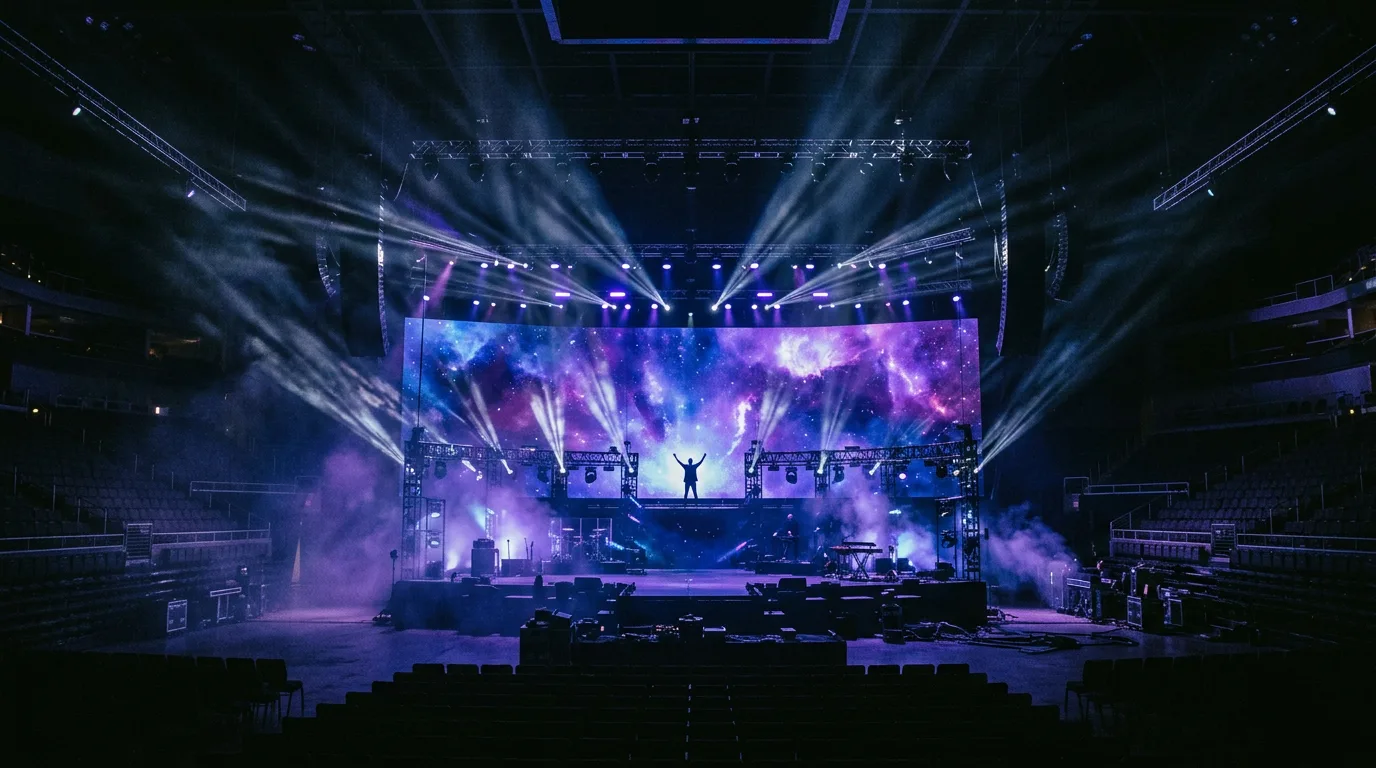
The stage is not a stage. It is a delivery system. The lighting, the tempo, the repetition, the duration: every variable is tuned for one output.
III. The violence that requires the state
Not every person in a dissociative worship state commits violence. Most do not. The induction produces compliance, not aggression, in the majority. But the minority who do commit violence, who bomb clinics, who kill doctors, who drive into crowds, who murder their children to “save” them from the coming tribulation, share a common precondition: they entered the act from a dissociated state in which the boundary between divine command and personal volition had been erased.
The cases are documented:
Michael Bray and the Army of God. Between 1978 and 1995, over 100 acts of violence were committed against abortion providers in the United States, including bombings, arsons, and assassinations. Michael Bray, convicted in 1985 for his role in a series of clinic bombings, authored “A Time to Kill,” a theological justification for murder. The men who killed Dr. David Gunn (1993), Dr. John Britton (1994), and Dr. George Tiller (2009) were embedded in churches where the rhetoric of spiritual warfare was indistinguishable from operational planning. Scott Roeder, who killed Tiller, attended a church where the pastor preached that abortion providers were “baby killers” who could be stopped by any means. Roeder described his act as obedience to God. He was not speaking metaphorically. He was speaking from inside the dissociative frame.
Jim Jones and Jonestown. Nine hundred and eighteen people died in Guyana in 1978. Jones was not a secular communist who happened to use religious language. He was a Pentecostal preacher who built his congregation on faith healing, speaking in tongues, and apocalyptic prophecy. The “White Night” suicide drills that preceded the final event were rehearsals conducted in a state of induced dissociation. The people who drank the poison were not making a rational choice. They were executing a command received in a state where the boundary between Jones’s voice and God’s voice had been systematically erased over years of trance induction.
The Branch Davidians. David Koresh was a Seventh-day Adventist who claimed to be the final prophet of Revelation. The 1993 Waco siege ended in the deaths of 76 people, including 25 children. Koresh’s authority was maintained through the same mechanism: sleep disruption, isolation, control of information, and the theological framing of his sexual access to underage girls as “celestial marriage.” The people inside the compound were not hostages in the legal sense. They were in a dissociative state from which exit felt like spiritual death.
Eric Rudolph. The Olympic Park bomber (1996), the abortion clinic bomber (1997), the lesbian nightclub bomber (1997). Rudolph was embedded in the Christian Identity movement, a theology that teaches white Americans are the literal descendants of the twelve tribes of Israel and that non-white people are subhuman. His manifesto explicitly frames the bombings as acts of religious warfare. He spent five years as a fugitive in the Nantahala National Forest, sustained by a network of sympathizers who shared his theological framework.
January 6, 2021. The spiritual warfare framing of the Capitol breach is not incidental. Multiple participants testified or posted that they understood the event as a battle against demonic forces. Ashli Babbitt, killed during the breach, had posted about spiritual warfare in the days before. The “Jericho March” that preceded the event was explicitly modeled on the biblical destruction of Jericho: march, shout, and the walls fall. The participants were not conducting a political protest. They were conducting a ritual. The dissociative state produced by weeks of election-denial prophecy, prayer rallies, and apocalyptic preaching was the precondition for the violence. The people who broke windows and assaulted police officers were, in their own testimony, obeying God.
The pattern is not that religion causes violence but that the dissociative state produced by engineered worship environments is the neurological precondition for violence that the person would not commit in a state of normal cognitive function. The theology provides the target. The dissociation removes the brake.
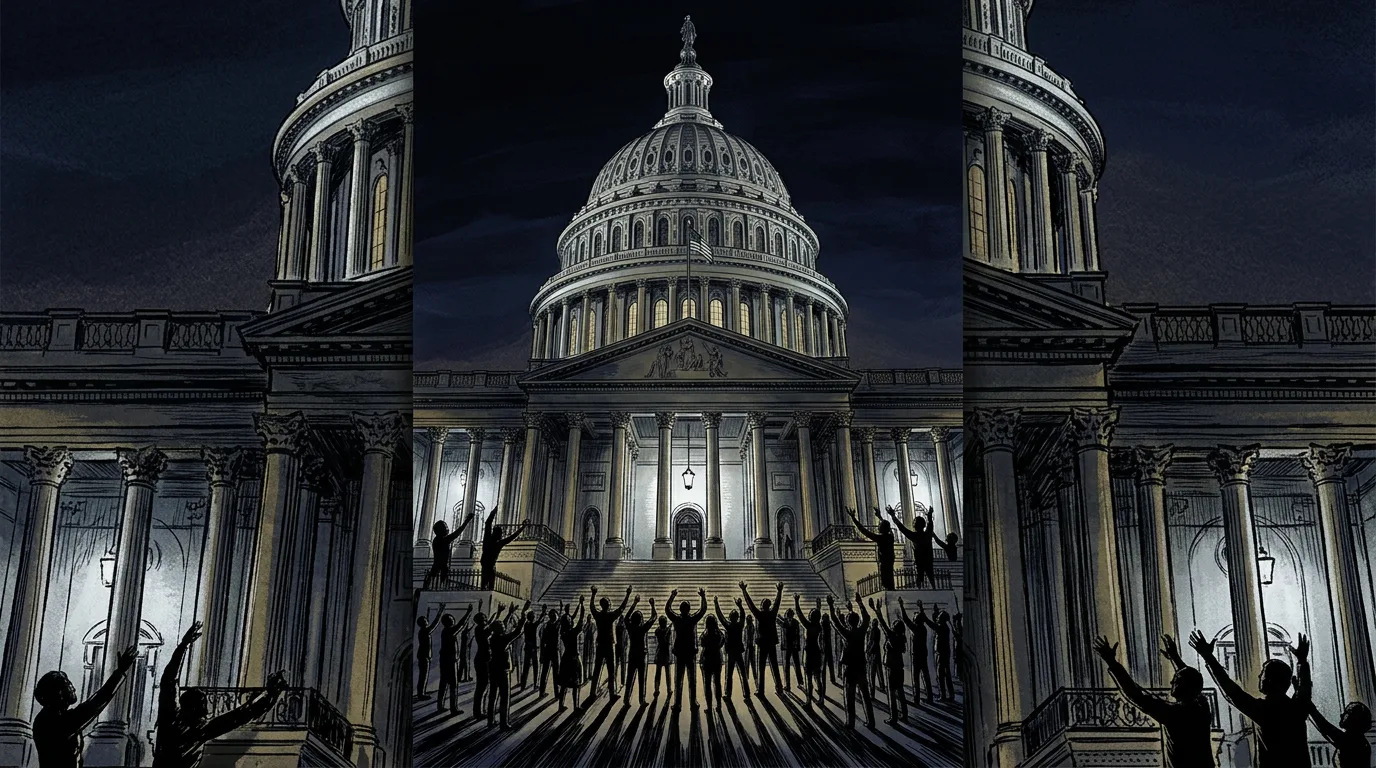
The government does not manufacture the panic. It harvests it. The distinction matters less than you think.
IV. The government harvests the output
This is the part that is least discussed. The government does not merely tolerate religious mass hysteria. It benefits. The benefit is structural, bipartisan, and documented.
Deflection. Every cycle of religious panic redirects public attention from material conditions. The Satanic Panic of the 1980s coincided with the dismantling of the social safety net, the savings and loan crisis, and Iran-Contra. The “War on Christmas” culture wars coincided with financialization and the opioid crisis. The spiritual warfare rhetoric of the 2020s coincides with the housing crisis and the failure to prosecute any senior official for 2008. A population fighting Satan cannot see that it is being robbed. The government does not need to manufacture the panic. It needs only to avoid correcting it.
Surveillance. Every moral panic generates demand for expanded authority. The Satanic Panic produced mandatory reporting laws and the normalization of child-protection surveillance later repurposed for broader monitoring. The post-9/11 framework produced the PATRIOT Act and the NSA’s bulk collection programs. The post-January 6 framework produced new FBI task forces and the legal infrastructure for designating domestic groups as threats. The panic creates the fear. The fear creates the mandate. The mandate creates the apparatus. The apparatus does not go away.
Political consolidation. The Religious Right is less a constituency the Republican Party represents than one it maintains in perpetual crisis. The mechanism, documented in every campaign cycle since 1980: identify an existential threat, frame it in apocalyptic language, present the party as the only defense against damnation, harvest the votes of people who believe they are voting for God rather than for a tax policy. A person in spiritual terror does not evaluate policy. They obey.
The Democratic Party benefits differently from the same source. The panic produces voters so extreme, so visibly dissociated, so willing to commit violence in God’s name, that the opposition can point to them and say: “This is what they are.” The violent fringe becomes the argument against the entire coalition. Neither party needs to address the material conditions that produce the panic. They need only to let it run.
The military-industrial application. If the enemy is not a nation but a spiritual force, the war has no end. No treaty. No negotiated settlement. The defense budget requires an eternal enemy. The religious right provides the vocabulary for an enemy that cannot be defeated because it is not material. A president who calls a military adversary “evil” is using the same word a pastor uses for a demon. The cognitive state that accepts one accepts the other.
The body count. The abstract benefits above produce concrete harm. The government writes the dissociative frame into law, and the law kills people.
Abortion bans. The Dobbs decision (2022) returned regulation to the states. Within eighteen months, fourteen enacted near-total bans. The legislative language is not medical. It is theological. “Fetal personhood” has no basis in embryology. It has an exact basis in Catholic and evangelical theology. The legislators attended the churches where the congregation entered a dissociative state in which “murder” felt like revealed truth. The legislation is the trance made statutory. The people harmed are the women who miscarry and are denied treatment. The fourteen-year-olds with no judicial bypass. The women who die of sepsis because a doctor waited for a heartbeat to stop. The policy is not a failure. The policy is the output.
Religious exemptions. The Religious Freedom Restoration Act (1993) was sold as protection for minority practice. Its actual function, per Burwell v. Hobby Lobby (2014): allow corporations to deny services, healthcare, and employment protections by claiming religious objection. A pharmacy refuses contraception. An employer excludes birth control from insurance. A foster agency rejects same-sex couples. The exemption is a sword, not a shield. The government wrote it. The government does not amend it because it is the deliverable promised in exchange for votes.
Children. Thirty-eight states shield parents from prosecution when a child dies because they prayed instead of calling 911. CHILD USA has documented hundreds of these deaths. Diabetes that became ketoacidosis. Appendicitis that ruptured. Meningitis that killed in the time it took to finish the prayer circle. The parents are not prosecuted. The law protects them. The law was written by legislators who attend the churches where the theology that killed the child is preached.
The funding pipeline. Since 2001, federal tax dollars have flowed to religious organizations under government contract. They may discriminate in hiring. They may proselytize. They need not meet secular accountability standards. The pipeline converts public money into religious infrastructure. The infrastructure produces the dissociative state. The state produces the political behavior. The behavior protects the pipeline. The taxpayer funds it and does not know.
Project 2025. The Heritage Foundation’s 900-page “Mandate for Leadership” is not a policy white paper. It is an operational plan to install religious governance across every federal agency. Its authors include members of the New Apostolic Reformation, which teaches the “Seven Mountains Mandate”: Christians must dominate government, education, media, entertainment, business, family, and religion. The plan was written by people who attended the churches described in this article, who entered the dissociative state described in this article, who received the “divine mandate” described in this article, and who then sat down and wrote the legislation. The trance is the policy process.
V. The loop
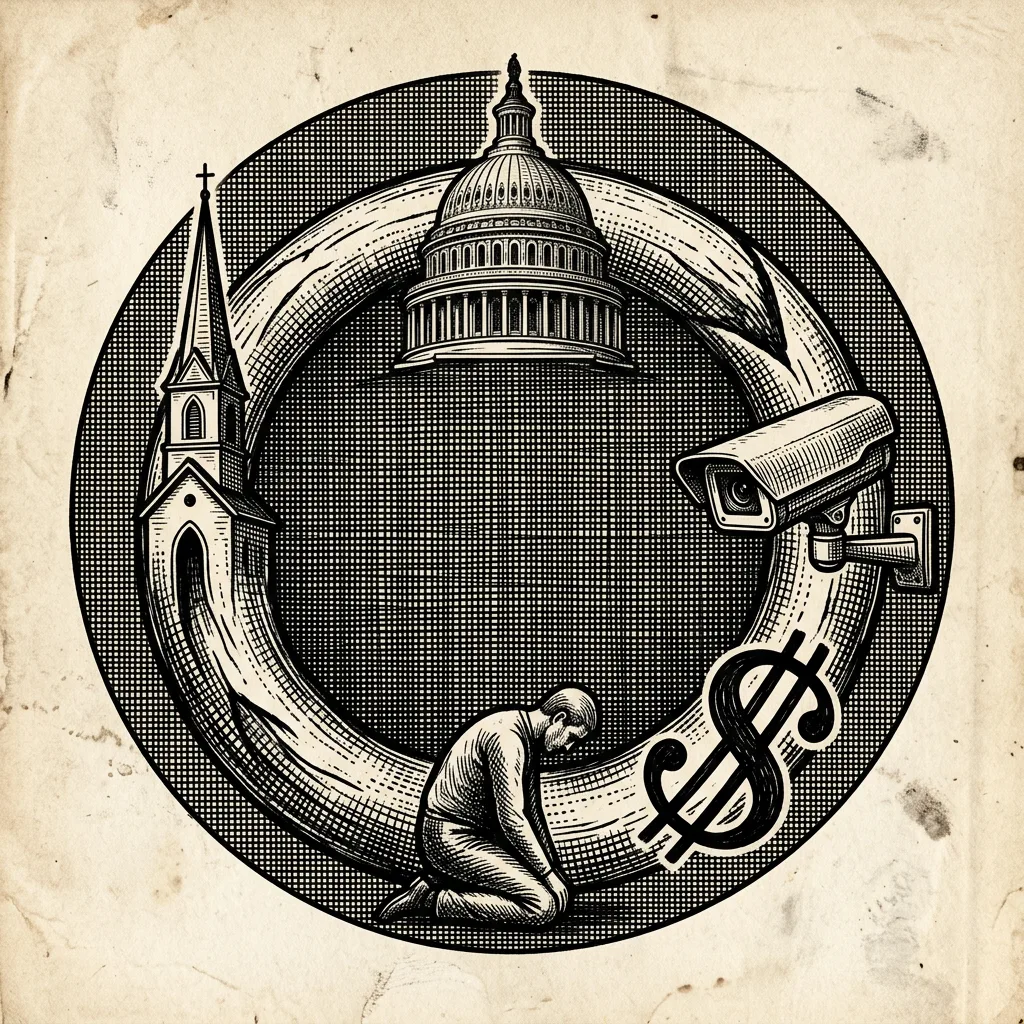
The system is a closed loop:
The church produces the dissociative state. The dissociative state produces the political behavior. The political behavior produces the crisis. The crisis produces the government response. The government response produces the surveillance and policy apparatus. The apparatus produces the material conditions (poverty, isolation, institutional distrust) that drive people back to the church. The church produces the dissociative state.
No single actor controls the loop. The pastor is not in a room with the senator. The senator is not in a room with the general. The general is not in a room with the defense contractor. They do not need to be. The loop is self-sustaining because each node’s output is the next node’s input, and no node has an incentive to interrupt the cycle. The church grows when people are afraid. The politician wins when people are angry. The agency expands when people are threatened. The contractor profits when the threat is eternal.
The person at the bottom of the loop, the one in the pew at 11 PM on a Wednesday, hands raised, tears streaming, prefrontal cortex going quiet, is not a conspirator. They are the fuel.
VI. What you are now responsible for
A grandmother praying the rosary is not in a dissociative trance. A congregation singing hymns on Sunday morning is not being programmed. The distinction between faith and the architecture of religious fraud is not the theology. It is the accountability. This article is not an argument against God. It is an argument against the machine that uses God as a delivery system for compliance, and against the government that has learned to feed on the output.
You now know the mechanism. That is the problem. Before this article, the loop was invisible to you, and invisibility was the condition that allowed it to run. You could not be expected to interrupt what you could not see. You can now.
The loop does not require your participation. It requires your silence. Every person who understands the mechanism and says nothing is a person the loop does not have to account for. The pastor does not need you in the pew. He needs you to not say, in daylight, with your critical faculties restored, “I saw what that was.” The legislator does not need your vote. He needs you to not call the office and name the bill. The contractor does not need your money. He needs you to not look at the pipeline and say, out loud, to another person, “That is what that is.”
The loop has survived for fifty years because the people who see it treat their understanding as a private opinion rather than a public fact. They think: “It’s not my place.” “Someone else will say it.” “I don’t want to be the person who makes it weird.” The loop is counting on that calculation. The loop has always been counting on that calculation. Every child who dies of treatable illness because a parent prayed instead of calling 911 dies inside a silence that thousands of people who understood the mechanism chose to maintain because speaking felt socially costly.
You do not have to fix the loop. You do not have to run for office or start an organization or leave your church. The minimum is smaller than that and harder than it sounds: you have to stop pretending you do not know. You have to let the knowledge cost you something. A sentence at the dinner table. A question after the service. A refusal to nod when someone says “God told me” and expects that to end the conversation. The loop runs on the assumption that the person who sees the mechanism will decide that seeing it is enough. That understanding it is the same as opposing it. It is not. Understanding without interruption is collaboration.
The organizations that do the actual work, Recovery from Religion, the Freedom of Mind Resource Center, CHILD USA, are underfunded because the people who could fund them are still deciding whether the problem is real. You have read the article. You have the sources. You have the mechanism, the cases, the legislation, the body count. The question is no longer whether the problem is real. The question is whether your understanding of it will remain a private comfort or become a public inconvenience.
The person in the pew at 11 PM on a Wednesday, hands raised, tears streaming, prefrontal cortex going quiet, will be there again next Wednesday. The loop will be running. The only variable that has changed is you.
If you are trying to understand how a person you love ended up inside this machine, Christianity and Reality addresses the gap between what the tradition asks and what the institution demands. The pattern vocabulary names the specific techniques used at each stage. How to Help Someone Who Has Been Destroyed by a Religious Cult or Institution is the practical field guide: what to say, what not to say, where to call, and how to help someone who is still inside, just out, or years out and still hurting.
Patterns in this piece
Crisis cycling
You called it a rough patch. You did not notice that the rough patches arrived on a rhythm, and that the rescue always came from the same hand that lit the fuse.
Authority laundering
You stopped asking for the evidence because the phrase sounded settled. 'Experts agree' was the whole argument. The authority was borrowed, never shown.
Synthetic consensus
Everyone's saying it. Everyone is one farm.
Preemptive dehumanization
You called them animals and you did not feel the flinch. That was the point. The word landed before the conscience could.
Sources
- Janja Lalich, Bounded Choice: True Believers and Charismatic Cults (2004)
- Margaret Singer, Cults in Our Midst (1995, revised 2003)
- Philip Zimbardo, The Lucifer Effect: Understanding How Good People Turn Evil (2007)
- Kenneth Lanning, Investigator's Guide to Allegations of Ritual Child Abuse (FBI, 1992)
- Pew Research Center: Religion and Politics (2025)
- Mark Juergensmeyer, Terror in the Mind of God (2000, revised 2017)
- Guttmacher Institute: State Abortion Policies (2026)
- CHILD USA: Faith-Based Medical Neglect Case Archive
- Andrew Newberg et al., 'The Measurement of Regional Cerebral Blood Flow During Glossolalia' (Psychiatry Research: Neuroimaging, 2006)
- Andrew Newberg, Why God Won't Go Away (Ballantine, 2001)
- American Psychiatric Association, DSM-5: Religious or Spiritual Problem (V62.89)
- Van Dongen et al., 'The Cumulative Cost of Additional Wakefulness' (Sleep, 2003)
- National Abortion Federation: Violence and Disruption Statistics
- Project 2025: Mandate for Leadership (Heritage Foundation, 2024)
- Burwell v. Hobby Lobby Stores, Inc., 573 U.S. 682 (2014)
- Americans United for Separation of Church and State: Faith-based funding reports
Tags
Related Essays
The Monster We Built: Charles Manson, the State, and the Satanic Panic That Never Was
Multiple sources (8)
The Red Scare Is Lazy and It Is Losing
Multiple sources (20)
The Square Is Not Yours Because You Named God
Multiple sources (6)