
The Sascha Riley Tapes: What the Record Actually Shows
Evidence-first pattern recognition. Sourced to reputable reporting.
This analysis discusses allegations of childhood sexual abuse, sex trafficking, violence against children, and murder. No graphic detail is provided beyond what is necessary for assessment.
If this content may be triggering, skip to recovery resources →
The Pattern
I need to tell you something before we get into the analysis.
I’m a survivor. I won’t say of what exactly, and I won’t perform my pain for credibility. But I know what it is to carry something that was done to you when you were too young to understand it, too small to stop it, and too alone to tell anyone who would believe you. I know what it is to have the thing that broke you treated as a debate topic by people who were never in the room. I know what it feels like when the world looks at your worst wound and says, “prove it.”
So when Sascha Riley’s recordings hit my feed in January 2026 (a man’s voice, shaking in places, describing things that no child should ever have to describe), I didn’t hear a “claim.” I heard a person. And I couldn’t stop listening.
I cannot verify what Riley says happened to him. I want to be clear about that. I’m not a journalist with subpoena power. I’m not an investigator with access to sealed military records. What I can do is what this project was built to do: name the shape of what’s happening in the information ecosystem around a story like this. Not determine truth; I don’t do that. But I can examine how a person’s testimony gets received, amplified, doubted, and processed, and what the machinery of reception does to the original words.
I built Deceit because I couldn’t unsee the patterns. Not as a career. Not as a brand exercise. Because once you’ve been the person no one believes, the person whose pain gets filed under “unsubstantiated,” you start seeing the gears everywhere. This article is what happens when I point that recognition at someone else’s story. My experience is not evidence for his. But it is a lens.
Riley is a decorated veteran who served his country in Iraq. Whatever one concludes about the specifics of his account, the act of coming forward (publicly, under his real name, describing childhood sexual abuse) required something. People who disclose childhood trauma carry enormous shame. The decision to speak is not nothing. I know that in my body. And it deserves to be met with more than reflexive dismissal.
This is not a piece that accuses Riley of lying. It is not a piece that declares him truthful. It is a piece written by someone who is deeply curious about this man, who feels for him regardless of what can and cannot be verified, and who believes that the minimum any person making serious allegations deserves is to be taken seriously enough to investigate. What follows is an analysis of the record, and of the system that received it.
For those who haven’t followed the story: in January 2026, a set of audio recordings swept across social media with a velocity that outpaced every institutional gatekeeper. They featured a man identifying himself as William Sascha Riley, also known as Manuel Sascha Barros, an Iraq War veteran who alleged he was trafficked as a child in the late 1970s and early 1980s by his adoptive father, a pilot connected to Jeffrey Epstein’s network. The allegations named █████ █████, Epstein, Rep. Andy Biggs, Rep. Jim Jordan, Sen. Lindsey Graham, Supreme Court Justice Clarence Thomas, Ghislaine Maxwell, and Vladimir Putin, among others. They described sexual abuse, physical torture, the production of child sexual abuse material, and the murder of children.
Who is Sascha Riley?
The biographical facts that appear corroborated across multiple independent sources are limited but real. And I find myself fixated on them, not because they prove anything, but because they sketch the outline of a life I recognize. A kid moved around the South. A military family. An adoption. The particular loneliness of being the child no one chose first.
Riley was born in 1973. He was adopted by a man named William Kyle Riley, who served in the U.S. Army and later worked as a helicopter pilot in the Atlanta area. Riley’s childhood was spent across several Southern states (Texas, Alabama, Tennessee, and Florida) in proximity to military installations. His adoptive father was married to a woman named Lynn Riley.
Riley himself served in the U.S. Army, including a deployment to Iraq. A DD Form 214 (military discharge document) under the name William Sascha Riley was provided to Snopes by Lisa Noelle Voldeng, the woman who published the audio recordings. His adult life was based in Oklahoma, specifically the Lawton and Elgin area, from approximately 2011 onward. He was divorced in 2021 in Elgin, Oklahoma.
These are the facts that multiple investigators have been able to confirm independently. They establish Riley as a real person with a real history: a child moved through the military foster system of the American South, an adult who served in combat, a man who came forward decades later with allegations that cost him privacy and exposed him to public scrutiny. That biography is not nothing. It is the foundation on which everything else rests.
The allegations: what Riley claims
Riley’s account, as presented across his 2021 Facebook posts and the 2025 audio interviews with Voldeng, describes the following structure:
Riley alleges that his adoptive father, William Kyle Riley, operated as a pilot and private investigator in the employ of Jeffrey Epstein. Through this connection, Riley says, young Sascha was transported to locations across the American South (farms, farmhouses, and a brothel in Duncan, Oklahoma) where he and other children were sexually abused, physically tortured, and filmed. Riley claims the abuse material was sold to Epstein’s clients, who included future political leaders.
Riley alleges he witnessed the murder of multiple children. He describes an incident in which a girl named Patricia was shot and killed in a farmhouse bedroom, after which █████ █████ entered the room and abused him. Riley claims he retaliated by inserting a tent peg into █████‘s rectum, severely injuring him.
He further alleges that a girl named Samantha (or “Sammy”), approximately ten years old, was held in the Duncan brothel, where she was entrusted with operational management and a firearm. Samantha was later tortured and killed in Enterprise, Alabama, after attempting to escape.
Riley says that in approximately 2008 to 2009, while stationed at Fort Carson, Colorado, a fellow soldier was found in possession of child sexual abuse material that appeared to depict Riley as a child. A commanding officer reportedly asked Riley about his resemblance to the boy in the footage.
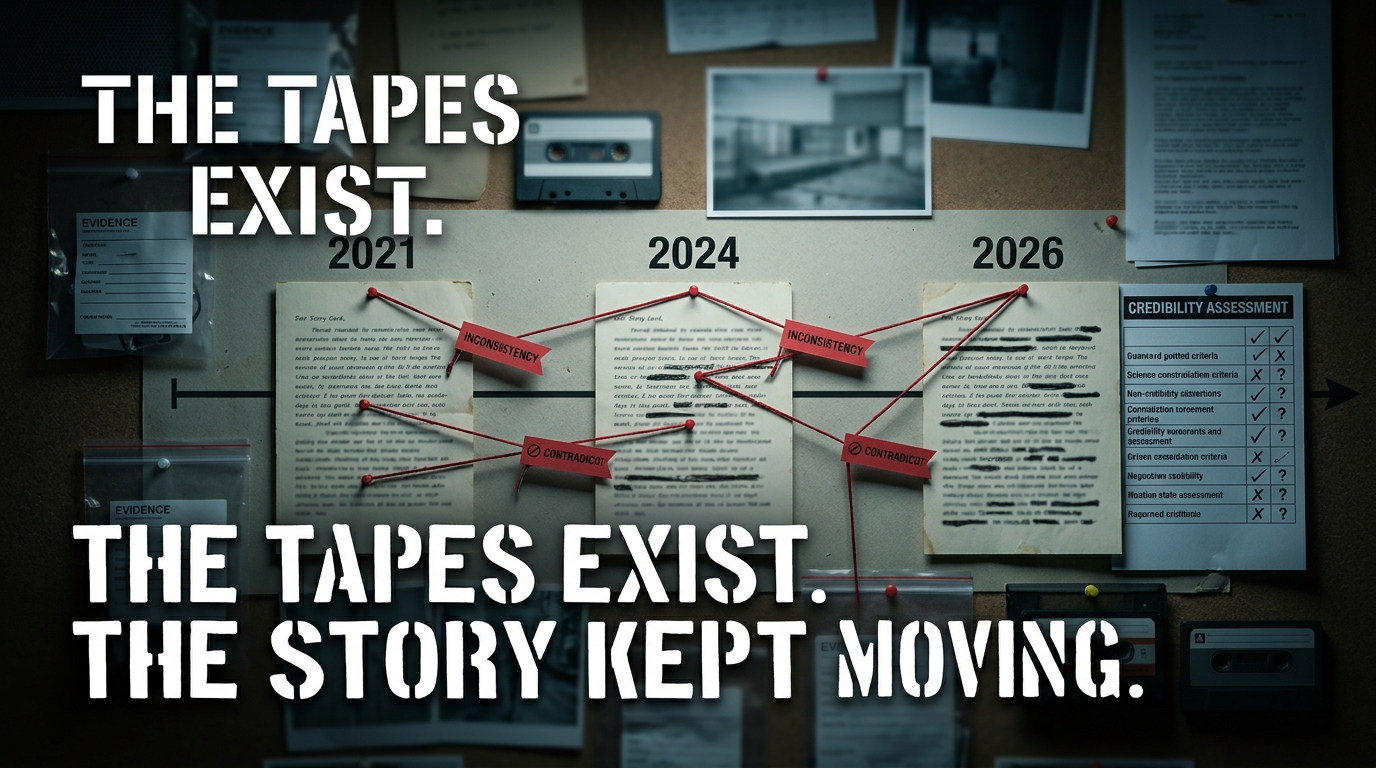
How the story changed: 2021 versus 2025
Riley’s account evolved between his first public disclosures in 2021 and the audio recordings released in November 2025. This deserves scrutiny. But it also deserves context. Trauma researchers have documented extensively that survivors’ narratives often shift over time, particularly when memories are recovered decades after the events. Details consolidate, names attach to faces, sequences reorder. This is not unique to Riley. It is a feature of how traumatic memory works, and it is not, by itself, evidence of fabrication.
That said, the specific nature of the changes matters.
The Samantha figure. In 2021 Facebook posts, Riley referred to this person only as “Sammy,” stating he did not know her real name. By 2025, she had acquired a full name, Samantha Jackson, and a substantially expanded role. In the 2021 version, Samantha was described in terms that suggest an adult woman: she managed the brothel’s daily operations, carried a firearm, regularly shot fellow victims, physically fought grown men, and had a sexual relationship with Riley. In the 2025 audio recordings, Samantha is presented more consistently as a child of approximately ten.
The 2021 characterization of Samantha as a competent, armed, sexually active ten-year-old who ran a brothel and executed people is difficult to reconcile with the developmental reality of a child that age. The 2025 version retreats from some of these details but does not fully resolve the contradiction.
A charitable reading, and one consistent with trauma literature, is that Riley’s memory of Samantha may blend a real person with protective fantasies. Children in extreme situations sometimes remember peers as more capable than they were, because the alternative (that no one could help) is unbearable. This does not mean Samantha did not exist. It may mean the memory of her has been shaped by the need for her to have been more powerful than a ten-year-old could be.
The Fort Carson incident. In 2021, Riley described personally confronting a group of soldiers who admitted to having seen the video. In the 2025 recordings, the story shifts: Riley learns about the video because a commanding officer calls him in to ask questions. The 2025 version aligns more closely with the limited external corroboration provided by First Sergeant Michael Balis, who confirmed to Snopes that a soldier was found with CSAM and that an officer asked Riley questions about a boy who resembled him.
The named figures. The individuals Riley names as his abusers, across both versions, share a distinctive property: they are people who became famous and powerful decades after the alleged events. In 1980, Andy Biggs was a college student in Utah. Jim Jordan was a high school student in Ohio. Vladimir Putin was a mid-level KGB officer monitoring foreigners in Leningrad. Ghislaine Maxwell was a teenager who did not meet Epstein until the late 1980s at the earliest.
No figure appears in Riley’s account who was famous in 1980 but is not famous now. The relationship between the alleged events and the fame of the accused runs exclusively in one temporal direction: toward the present.
Geographic coherence. Riley’s childhood was spent in Texas, Alabama, Tennessee, and Florida. His adult life was in Oklahoma. The brothel he describes was in Duncan, Oklahoma, approximately forty minutes from where he lived as an adult in 2021, when he first began making disclosures. The abuse locations he names track more closely with his adult geography than his childhood one.
Timeline drift. The Facebook posts from 2021 place certain events (particularly those involving Samantha) at approximately 1983 to 1984, based on Riley’s stated age. The 2025 audio recordings compress the timeline to 1980 to 1982. The song “Bette Davis Eyes,” which Riley associates with a video, was not released until 1982, creating a chronological conflict with the earlier dating.
Media reception: the machinery of reception
The Riley story followed a distribution pattern I recognize, not just from studying it, but from having been processed by the same system. A person comes forward. The institutions that might receive the testimony either decline to cover it or cover it cautiously. The absence of institutional response is then interpreted, simultaneously, as proof of conspiracy and proof of fabrication. Both readings serve the same function: they let everyone else off the hook.
Social media amplification. The audio recordings were posted on Voldeng’s Substack, “Outlaws of Chivalry,” on November 23, 2025. They gained viral traction in January 2026 across Threads, Bluesky, Facebook, Instagram, Reddit, TikTok, X, and YouTube. On Reddit, posts in r/Epstein and r/Military drew hundreds of upvotes and comments. Some users noted what they described as coordinated posting activity around the story; this observation is unverified.
Platform moderation and the amplification loop. Here’s the mechanism, and I’ve watched it work in real time. Facebook users reported reduced reach on posts mentioning Riley. Whether this reflected deliberate suppression, standard content moderation responding to unverified allegations involving named public figures, or ordinary algorithmic filtering is unclear, and the distinction matters. What happened next is what concerns me: the moderation narrative became its own engine. The absence of coverage was reclassified by some supporters as evidence of a cover-up. The silence became louder than the testimony. This is a pattern I can name because I’ve seen it eat other stories alive: when the institution’s failure to respond becomes the story, the original testimony gets buried under the meta-narrative. Riley’s actual words became secondary to the argument about whether his words were being censored.
Mainstream media noncoverage. No major American news outlet (the New York Times, Washington Post, CNN, NBC, CBS, ABC) published original reporting on Riley’s allegations as of mid-2026. The Hindustan Times ran an explainer. Snopes published a detailed fact-check. Dr. Laura Robinson, a sociologist who has written on the satanic panic, published two extensive analytical pieces. Jordan Liles, a fact-checker, investigated independently.
The binary that formed is what I’d call choice foreclosure: the alternatives aren’t refuted, they’re made invisible. In public discourse, the story was either too dangerous for outlets to touch (therefore true, therefore believe it without evidence) or it lacked corroboration (therefore false, therefore dismiss it). No third option gained traction. Few voices said: this is not independently corroborated, and the absence of formal investigation is itself worth examining. I’m not claiming coordination. I’m claiming that the structure of the discourse foreclosed the middle position.
The fact-check consensus. Snopes concluded: “No credible evidence supported the allegations regarding Epstein, the president and other prominent men.” Robinson’s analysis was more measured but reached a similar conclusion: “Based on the information I have in January 2026, I believe this story to be false.” Both emphasized they were not accusing Riley of conscious deception.
I want to be precise here, because this matters: a fact-check that says “no credible evidence supports this” is not the same as a formal investigation that says “we looked and found nothing.” The first is a statement about what’s publicly available. The second is a statement about what exists. Snopes and Robinson examined what was accessible. No one with subpoena power, archival access, or institutional authority has conducted a formal investigation into the underlying claims. The distinction is not trivial.
The data points: what supports and what undermines
Points that lend credibility, and deserve weight
These are not trivial. In a case where institutional records have been lost, sealed, or never created, biographical corroboration and partial witness confirmation carry genuine evidentiary value:
- Riley is a real person with a verifiable military record (DD Form 214 confirmed). He is not an anonymous internet claim. He put his name, his face, and his service record behind these allegations.
- He was genuinely adopted by William Kyle Riley, who was genuinely a pilot. The foundational claim (that his father had the means and mobility to transport a child across state lines) is structurally plausible.
- The Riley family did live in the Southern states Riley describes, in proximity to military bases. The geography of his childhood is real.
- First Sergeant Michael Balis confirmed that a soldier was found with CSAM at Fort Carson around 2008 to 2009 and that an officer asked Riley about a boy who resembled him in a video. This is not nothing. It places Riley in a documented incident involving child exploitation material that depicted someone who looked like him. The significance of this should not be minimized.
- Riley met with aides from the House Oversight Committee (externally confirmed). Congressional staff do not typically take meetings with people they consider fabricators.
- Riley contacted the Lawton Police Department and the Oklahoma State Bureau of Investigation in 2021 (partially confirmed via his Threads posts; OSBI declined to confirm or deny records). He attempted to use legitimate legal channels before going public.
- Late disclosure of abuse is well-documented in clinical literature and is not itself a sign of fabrication. Many survivors do not speak for decades. The fact that Riley was fifty when he first came forward is consistent with, not contrary to, the trauma literature.
- Riley has physical scars that he attributes to the abuse. No investigator has examined these publicly, but their existence has not been disputed.
- The Epstein network was real. Child sex trafficking by powerful men is not a fantasy. The institutional failure to prosecute it is documented and ongoing.
Points that raise questions
These are the difficulties that any honest assessment must acknowledge. They do not disprove Riley’s account, but they complicate it:
- No documentary evidence (court records, police reports, medical records, CPS files, newspaper articles, independent witness testimony) has been produced to corroborate the abuse by named public figures. However: the absence of records is not the same as the absence of events. CPS files from the 1980s in rural Southern counties are frequently lost, destroyed, or never digitized. Charter Woods Hospital, which Riley says holds a 1989 disclosure, is closed. The institutional infrastructure that would preserve evidence of these crimes has largely dissolved.
- The named figures’ known whereabouts during the alleged period raise questions (Biggs was a student in Utah; Jordan was in high school in Ohio; Putin was a KGB officer in Leningrad; Maxwell was a teenager in England). It is worth noting, however, that our knowledge of these individuals’ movements in the early 1980s is incomplete. Public biographies are not exhaustive records.
- The “Bill Riley” in the Epstein files is William Henry Riley, a private investigator for a firm called Riley Kiraly, not William Kyle Riley, Sascha’s adoptive father. The conflation appears to be an error by Voldeng, not by Riley himself.
- William Kyle Riley’s military service (until 1994) makes it difficult to reconcile with the claim that he simultaneously served as █████‘s personal pilot. █████ did not own aircraft until 1989. However, “serving as a pilot” and “owning aircraft” are not the same thing; charter and lease arrangements existed.
- The Samantha narrative, in its 2021 form, describes a ten-year-old with adult capabilities that strain credulity. The 2025 version is more restrained.
- Geographic details track Riley’s adult Oklahoma life more closely than his childhood in other states. This could reflect memory formation around familiar locations, or it could reflect where events actually occurred.
- Voldeng, who published the recordings, explicitly stated she is not a journalist and could not provide documentary evidence beyond the DD Form 214. Her framing sometimes discouraged listeners from seeking corroboration, positioning belief itself as a moral virtue. I recognize this move. It inverts the burden: instead of evidence supporting the claim, the claim’s emotional force becomes the evidence. The feeling of believing becomes the proof. That’s a weakness of the presentation, not necessarily of Riley’s underlying experience, but it’s a weakness that gives dismissers exactly the handle they need.
The Balis confirmation: what it actually proves
The single strongest piece of external corroboration is Balis’s confirmation. It is worth being precise about what it establishes:
- A soldier at Fort Carson was found with CSAM around 2008 to 2009.
- An officer asked Riley whether a boy in a video resembled him.
That is the full extent of what Balis confirmed. He did not confirm that the boy was Riley. He did not confirm that the video depicted █████ or any named figure. He did not confirm the name Riley gives for the officer (which varies between “Colasanto” in the audio and “Michael Balis” in other accounts). He did not see the video himself.
A 2009 news report (referenced in Snopes’ reporting) documents two Fort Carson officers arrested for CSAM possession, but the names and circumstances do not align precisely with Riley’s account.
The pattern question, and its limits
Dr. Robinson’s analysis drew a parallel to the satanic ritual abuse panic of the 1980s, particularly the Michelle Smith case (Michelle Remembers, 1980) and the McMartin Preschool trial (1984 to 1990). The structural similarities she identified include:
- Extraordinary allegations involving elite conspirators.
- A single primary witness whose testimony is the foundation.
- Logistics that are difficult to verify decades later.
- The absence of physical evidence explained by suppression or destruction.
- Named figures whose known whereabouts raise questions.
These parallels deserve consideration. But I need to say this clearly, because I’ve watched pattern-matching get used as a dismissal tool: the satanic panic comparison has also been deployed to bury real survivors. The Epstein network was not a moral panic. It was a documented criminal enterprise that operated for decades with institutional protection. The fact that a story resembles a previous false story does not make it false. The fact that powerful people have been caught before does not mean they cannot be caught again.
Here’s what I think is happening, and I say this as someone who built a project around naming patterns: pattern recognition cuts both ways. It can reveal the machinery of deception, and it can become the machinery of dismissal. Robinson identified a structural resemblance and called it a prior probability. Fair. But the prior probability of elite sexual exploitation, post-Epstein, is not what it was in 1985. We now know, with documentary certainty, that wealthy and connected men trafficked children with impunity. The question is no longer whether such networks can exist. The question is whether this specific account describes one.
The pattern argument establishes a prior. It does not establish a verdict. And priors are supposed to update when new evidence arrives. No new evidence has been sought. The prior has been frozen in place and called a conclusion.
What would change the assessment
The story is not unfalsifiable. Several categories of evidence, if produced, would materially shift the credibility calculus:
- Hospital records from Charter Woods Hospital in Dothan, Alabama (now closed), which Riley claims contain a 1989 disclosure.
- Military records for William Kyle Riley showing unexplained absences or AWOL periods during the alleged trafficking years.
- Court-martial records for the Fort Carson CSAM case that identify the boy in the video.
- CPS reports from any of the states where Riley lived as a child.
- Corroborating testimony from any other person present at the described events.
- The Epstein files, if released in full, containing any reference to William Kyle Riley, the described locations, or the named events.
As of July 2026, none of these have been produced.
What this is not
This analysis does not determine whether Riley was abused as a child. The biographical facts (adoption, military family, Southern childhood, a father with mobility and connections) are compatible with many forms of trauma. Physical scars, if they exist, may testify to real violence. The question of whether Riley suffered abuse is separate from the question of whether the specific narrative involving █████, Epstein, and the named politicians is accurate in every detail.
This analysis does not accuse Riley of deception. False memories are well-documented. Trauma can distort recall. A person can be sincerely convinced of events that did not occur precisely as remembered. Robinson emphasized this repeatedly: “I don’t think Riley is lying. I don’t want to accuse him of that.” But the inverse is also true: a story can contain distortions, conflations, and temporal errors and still be rooted in real events. Imperfect testimony is not false testimony.
This analysis does not argue that the Epstein files should remain sealed. The Epstein Files Transparency Act was signed into law in November 2025. The files should be released. The public’s legitimate anger at institutional failure is real and justified. The fact that no major outlet has investigated Riley’s claims with the resources they would deploy if similar allegations were leveled against less powerful people is worth examining. I’ll name the pattern as I see it: the machinery doesn’t need to actively silence a person. It can simply not investigate them. Whether that noncoverage reflects editorial caution, resource constraints, or something less charitable, I cannot say. But the effect is the same.
The honest summary
I’ll be honest with you: I don’t know if Sascha Riley’s story is true. I don’t know if it’s true in its details, or true in its bones, or true in the way that trauma is true, which is to say, real to the person carrying it whether or not a court would accept it as evidence.
What I know is this: Sascha Riley is a real person with a real military record, a real history of adoption in the American South, and a real set of scars that no one has examined in a formal evidentiary context. I believe it is possible that something happened to him. I cannot tell you what. That is not my role.
What he describes in the audio recordings (a multi-state trafficking ring involving future presidents, Supreme Court justices, and foreign intelligence officers, operating from farmhouses in Tennessee and brothels in Oklahoma in the early 1980s) is not corroborated by documentary evidence as of this writing. But I need you to understand what “not corroborated” means here, because the phrase can do work it hasn’t earned. It means: no formal investigation with subpoena power has been conducted. The Epstein files remain partially sealed. The hospital that would hold records is closed. No major news outlet has attempted boots-on-ground investigation. Fact-checkers examined what was publicly available and found no supporting evidence. That is not the same as “disproven.” But it is also not the same as “no one looked.” People looked. They looked at what was accessible. The question is whether what’s accessible is all there is.
The story changed between 2021 and 2025 in ways that are consistent with both trauma-memory reconstruction and narrative shaping. The named figures’ documented whereabouts during the alleged period raise genuine questions. The Fort Carson incident is partially corroborated. The geographic details are ambiguous.
And the media (the information ecosystem that received this testimony) processed it through two mutually exclusive frames simultaneously: too dangerous to touch, or too weak to matter. Both frames produce the same outcome. No formal investigation. No institutional accountability for the noncoverage. The machinery hums. The person who came forward gets filed.
I recognize that machinery. I built this project because I couldn’t stop seeing it. The way an institution’s nonresponse gets reclassified as evidence. The way a person’s imperfect testimony becomes the story instead of the absence of investigation. The way “no credible evidence” gets flattened into “this didn’t happen” by everyone who shares the fact-check without reading past the headline. I’ve been on the receiving end of that flattening. I know what it does to a person.
The most honest answer to “is this true?” is: the specific narrative as presented cannot be confirmed in its details, and some elements are difficult to reconcile with known facts. Whether it contains a kernel of real trauma (or more than a kernel) distorted by memory, time, and the normal imperfections of traumatic recall, is a question that cannot be answered without evidence that has not yet been sought, let alone produced.
Riley came forward. He named names. He put his service record and his identity on the line. The people he accused have not been charged with crimes, and they deserve the presumption of innocence. But Riley also deserves something: a serious investigation by people with subpoena power, archival access, and the institutional authority to determine whether the records he says exist actually do.
Until that happens, the honest position is not “this is false.” It is “this is not independently corroborated, and no formal investigation has been conducted.” And the difference matters. The difference is where the question lives.
I think about Riley in Oklahoma. Divorced. Fifty years old. Carrying something he finally said out loud, and watching the internet turn his worst memory into content: memes, hot takes, “debunk” threads, people who’ve never been touched by violence arguing about whether his scars are real. I think about what that must feel like. I don’t have to imagine very hard.
I don’t know if I believe him. I know I believe for him. And I think that’s allowed. I think you can look at the evidence honestly and still say: this man deserves better than what he got. This man deserved someone to sit down, look him in the eye, and say, “I’m going to find out.” No one did that. And that failure belongs to the system, not to him. It belongs to the outlets that didn’t send a reporter. It belongs to the platforms whose moderation choices remain unexplained. It belongs to the fact-checkers who checked what was in front of them and called it done. It belongs to all of us who consume these stories as entertainment rather than as a person’s life.
I built this project because I was tired of watching the machinery process people who come forward into content. Riley’s story is not content. It is a man’s life, waiting for someone with power to take it seriously.
A note on the GoFundMe
A fundraiser titled Documenting Sascha Riley’s Truth exists on GoFundMe, organized by an entity called “K2 Gives” (Las Vegas, NV). As of this writing, the campaign has received zero donations. It states that funds would go toward a mini-documentary, a dedicated awareness website, and media outreach, and explicitly states that no money goes to Riley directly.
I include this link for completeness, not as an endorsement. I have not been able to verify the organizer’s identity, their relationship to Riley, or whether Riley has publicly endorsed this campaign. The fundraiser’s claims about how funds will be used are self-reported and unaudited. If you choose to donate, you are relying on the organizer’s stated intentions. I cannot confirm them.
What I can say is this: Riley’s story has been amplified by millions and investigated by almost no one with institutional resources. Whether a community-funded documentation effort is the right response to that gap is a question each reader must answer for themselves. Donating is not a substitute for investigation, and it is not a statement about the truth of Riley’s claims.
Image: Original editorial illustration generated for this article. No photograph of Sascha Riley is used. Riley’s likeness is not reproduced here out of respect for the fact that he has not been charged with any crime and is not a public figure in the traditional sense.
If you or someone you know has experienced sexual abuse, the National Sexual Assault Hotline is available 24/7 at 1-800-656-4673 or online at rainn.org.
Sources
- Snopes: Examining Sascha Riley’s audio recordings alleging abuse by Epstein, █████
- Dr. Laura Robinson: Sascha Riley and the Long Hangover of the Satanic Panic
- Dr. Laura Robinson: I Have Debunked Your Article On Sascha Riley
- Lisa Noelle Voldeng: Outlaws of Chivalry (Substack)
- Hindustan Times: Sasha Riley, 5 things to know
- Reddit r/Epstein: Community discussion and source compilation
- Reddit r/OutOfTheLoop: What’s going on with the Sascha Riley allegations
- GoFundMe: Documenting Sascha Riley’s Truth (K2 Gives)
Related Essays
From Jane Doe to “Prince Andrew’s Accuser”
Multiple sources (15)
Virginia Giuffre Was a Child We Failed
Multiple sources (7)
The AI image that proved what you already believed
Multiple sources (4)