
From Jane Doe to “Prince Andrew’s Accuser”
Evidence-first pattern recognition. Sourced to reputable reporting.
This analysis discusses childhood sexual abuse, sex trafficking, victim blaming, and suicide reporting without graphic detail.
If this content may be triggering, skip to recovery resources →
The Pattern
Virginia Giuffre was rarely allowed to enter a headline as herself.
She was a Jane Doe. An Epstein accuser. Prince Andrew’s accuser. A sex slave. A woman in a photograph. A credibility problem for powerful men.
Each description carried part of the truth. Together they often reduced a person to her relationship with the men she said abused her.
I wanted to know whether that changed over time. I also wanted to answer a harder question: who did good reporting, and who should be remembered as complicit?
The record does not divide itself into heroes and villains. Some tabloid reporting broke open a story that prestige outlets had missed or softened. Some institutions had defensible legal concerns and still failed the public. Some journalists returned to the record and corrected earlier failures. Others helped powerful people turn a survivor’s credibility into the story.
This is my judgment after reviewing court records, contemporary reports, retrospective investigations, and the language used to describe Virginia from 2011 through the publication of Nobody’s Girl in 2025.
What I mean by complicity
I do not mean every reporter who used the word alleged. That word can be necessary when a claim has not been adjudicated. I do not mean every editor who asked for corroboration. Journalists should test claims, including claims I believe.
I also do not mean everyone photographed with Epstein committed a crime. A photograph, flight log, contact-book entry, or dinner invitation is not proof of abuse.
Complicity is a stronger charge. I reserve it for conduct that protected the powerful at the expense of the record: knowingly minimizing credible allegations, helping run a smear, applying influence to keep a survivor unheard, or treating access to elite people as more valuable than the evidence.
Institutional failure is broader. A newsroom can fail without joining a conspiracy. Fear of litigation, narrow editorial rules, deference to status, and the pursuit of access can all produce silence without anyone receiving an order.
That distinction matters. If every failure becomes a conspiracy, the documented pressure disappears into noise.
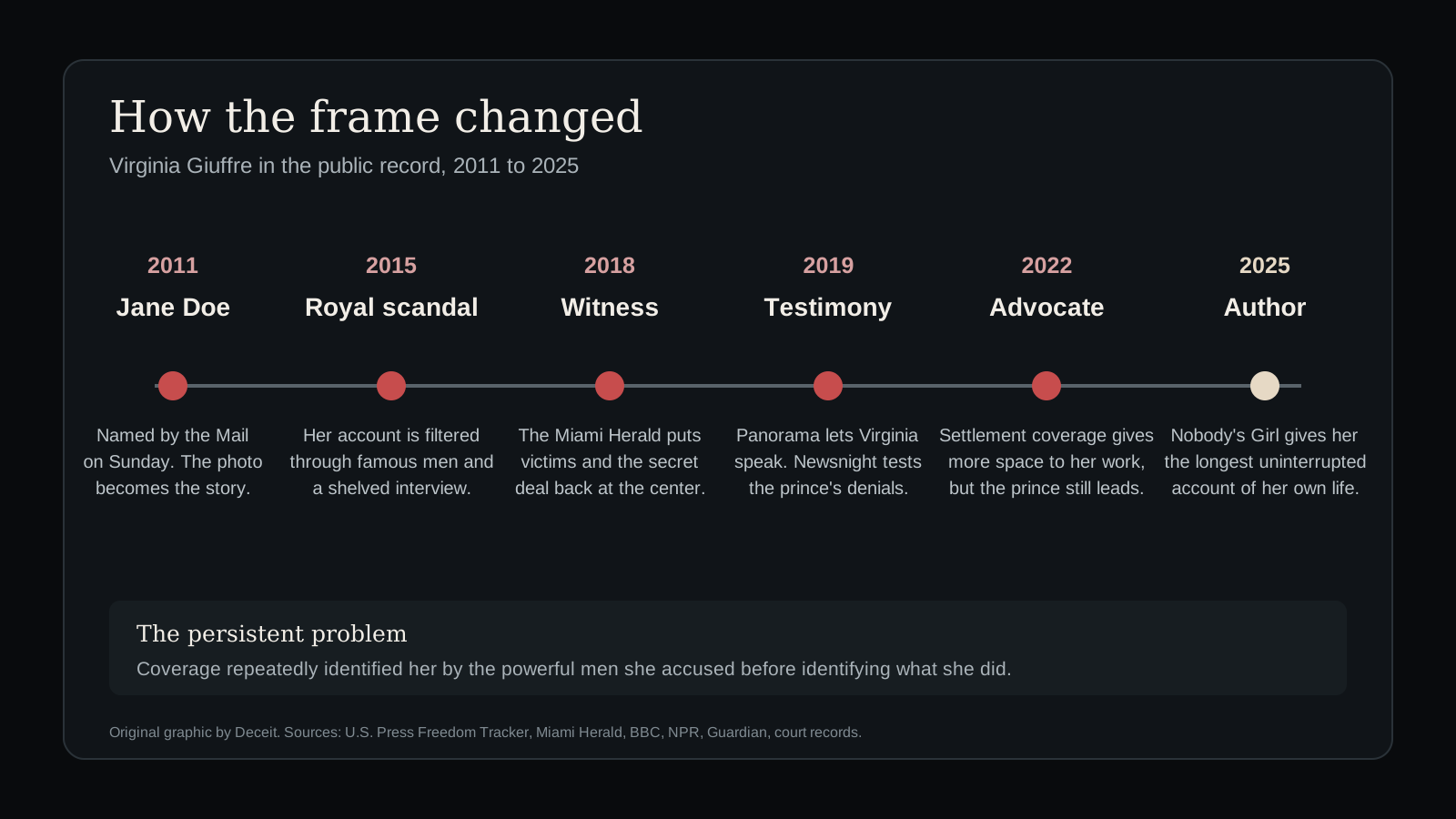
Original graphic by Deceit. Sources: Churcher’s 2011 reporting, Perversion of Justice, BBC Panorama, NPR on ABC’s unaired interview, and the federal court record.
2011: the tabloid that put her name into public view
The first reporting that changed Virginia’s public position came from Sharon Churcher at the Mail on Sunday.
In 2011, Churcher identified Virginia Roberts, as she was then known, as one of the Jane Does in litigation involving Jeffrey Epstein. The U.S. Press Freedom Tracker describes Churcher’s article as the first in a series. Virginia provided the photograph of herself at 17 with Prince Andrew and Ghislaine Maxwell. The image made denial more difficult because it placed three people in the same room.
That reporting deserves credit. Churcher found Virginia, listened to her, obtained evidence, and brought her account to a mass audience years before most American outlets treated Epstein as an urgent story.
The credit needs an asterisk.
The Guardian later reported that the Mail on Sunday paid Virginia $140,000 to publish the photograph and $20,000 for two interviews. Payment does not make the photograph false. It does create a financial fact that readers deserve to know, especially when opponents later tried to use money as a substitute for disproving her account.
The coverage also transformed the photograph into the center of the story. It was evidence of a meeting. It was not evidence of everything Virginia said happened before or after it. Yet the image became easier to repeat than her full testimony. The public learned the outline of a royal scandal before it learned the structure of the trafficking system.
This is the first contradiction in the record. A tabloid helped Virginia become visible. The same commercial machinery also made her pain a product.
Before Virginia: the prestige failure that explains the climate
Virginia was not the first woman to speak to a reporter about Epstein.
In 2002, Vicky Ward interviewed Annie Farmer, Maria Farmer, and their mother, Janice, for Vanity Fair. The sisters alleged that Epstein had abused them and that Maxwell participated. Their allegations did not appear in the 2003 profile.
NPR’s 2019 reconstruction gives both sides. Former editor Graydon Carter said the reporting did not meet the magazine’s legal sourcing requirements. Former colleagues described Epstein berating and pressuring Carter. They also described frightening incidents around Carter, while acknowledging there was no evidence tying Epstein to those incidents.
The omission matters even if Carter’s explanation is accepted. Three members of one family say they spoke on the record. The published profile examined Epstein’s money and elite social world while leaving the abuse allegations out. Readers received mystery and glamour without the warning those women tried to provide.
Ward’s later conduct is harder to excuse. NPR reported that in a 2011 essay she described Epstein’s sexual conduct with minors as “peccadilloes” and defended Maxwell. She did that after the Farmers had told her Maxwell participated in Epstein’s predatory conduct. Ward later returned to tougher reporting. The 2011 minimization still belongs in the record.
That is closer to complicity than ordinary editorial caution. It took known allegations and made a powerful person easier for elite society to accept again.
2015: the interview ABC did not air
In 2015, ABC News recorded an interview with Virginia. It did not broadcast it.
Four years later, leaked video showed anchor Amy Robach saying ABC had “quashed” the interview. She described pressure from Buckingham Palace and said the network feared losing access to the royal family. ABC said there was no truth to the claim that outside pressure caused the decision. Robach later said the reporting had not met ABC’s standards.
NPR’s detailed account explains the editorial problem. A judge had removed parts of Virginia’s allegations from a court filing shortly before the interview. That meant ABC could no longer rely on the legal privilege attached to reporting allegations contained in public court records. The network said it could not independently corroborate enough of the claims.
That explanation is plausible. It is not the whole story.
Alan Dershowitz told NPR that he called ABC before the planned broadcast to argue against airing Virginia’s allegations. He said he spoke with two producers and an attorney. His stated reason was direct: he did not want ABC to enhance her credibility.
That is documented pressure by a powerful person with personal and professional interests in the coverage. It does not prove ABC surrendered to him. It proves ABC was not making its decision in a pressure-free room.
There is another fact that cannot be omitted. Virginia and Dershowitz ended their defamation litigation in 2022. Virginia said she recognized that she might have made a mistake in identifying him. Dershowitz maintained his denial and acknowledged that his own allegation of an extortion plot involving her attorney was mistaken. No money changed hands in that resolution.
ABC therefore had a real verification problem. It also had a major interview with a trafficking survivor, a powerful subject lobbying against her credibility, and years in which it could have reported what it could establish while continuing to investigate what it could not.
I would call the decision an institutional failure. I would not call it proven collusion with Buckingham Palace. The record supports a missed opportunity under pressure. It does not tell us every motive behind the final decision.
2018: Julie K. Brown changed what the story was about
Julie K. Brown’s Perversion of Justice investigation for the Miami Herald is the clearest example of reporting worth remembering.
Brown did not treat Epstein as a strange rich man with famous friends. She treated the secret non-prosecution agreement, the extraordinary jail arrangement, and the silencing of victims as the story. She interviewed Virginia and other survivors. She reconstructed how federal prosecutors made a deal without informing the victims whose rights were at stake.
Brown has described how the Herald investigated Epstein and his enablers. The full series gave readers documents, timelines, interviews, and institutional names.
The work mattered because it changed what the story was about. Epstein’s wealth stopped being the source of fascination. It became part of the explanation for why accountability failed. The women stopped appearing only as accusations attached to famous names. Their treatment by the justice system became evidence of what power had purchased.
Brown did what journalism is supposed to do. She did not ask whether the story had enough celebrity heat. She asked why the documented facts had produced so little consequence.
2019: two BBC programs did different necessary work
The BBC’s Newsnight interview with Prince Andrew is remembered because his answers were so disastrous. Emily Maitlis asked specific questions about Virginia’s account, the photograph, the date, the nightclub, and his claimed inability to sweat. The interview let the public assess his denials without a palace statement sanding down the edges.
That was accountability reporting. It was still centered on him.
Weeks later, Darragh MacIntyre’s Panorama documentary, produced by Laura Burns, gave Virginia her first British television interview. She spoke for herself and described Maxwell’s alleged role alongside Epstein. The sequence matters. Newsnight tested the powerful man’s explanation. Panorama restored the survivor as a speaking subject.
Both teams deserve credit. Emily Maitlis, producer and booker Sam McAlister, and the Newsnight team created a record of the prince answering detailed questions. MacIntyre, Burns, and the Panorama team created space for Virginia’s account rather than treating her only as the source of allegations put to someone else.
The distinction is small on a production schedule and enormous in a survivor’s life. Being discussed is not the same as being heard.
The language kept putting the men first
Even strong reporting repeatedly described Virginia as “Prince Andrew’s accuser” or an “Epstein accuser.” Those labels are concise. They also make the powerful man the organizing fact of her identity.
“Sex slave” was worse. It conveyed coercion, but it froze her inside what was done to her. The phrase invited lurid interest and made it easier for hostile outlets to argue over whether she behaved like their imagined version of a captive. One hostile tabloid headline later described her as a money-hungry “sex kitten.” The point was not to test evidence. It was to replace a witness with a sexualized caricature.
This framing created a trap.
If Virginia showed agency, detractors said she could not have been trafficked. If she appeared vulnerable, coverage reduced her to damage. If she accepted payment for an interview, the payment became her motive. If she fought for a settlement, the settlement became her motive. Powerful institutions were permitted strategy. She was required to perform purity.
Trafficking does not require a person to be physically confined every minute. Trauma does not produce a single approved personality. A survivor can make choices inside coercion and still be coerced. Reporting improved when it explained those facts instead of demanding that Virginia resemble a stereotype.
2022 to 2025: advocate, settlement, author
Coverage of Virginia’s 2022 settlement with Prince Andrew often remained royal coverage. The size of the payment, the effect on the monarchy, and Andrew’s future dominated. Virginia’s survivor advocacy appeared, but frequently as a condition of the settlement or a detail in his collapse.
Then Nobody’s Girl changed the available frame.
The memoir did what a deposition, television package, and headline could not. It gave Virginia sustained control over sequence and emphasis. She could begin before Epstein. She could write about family, horses, shame, survival, motherhood, advocacy, and the cost of being publicly doubted. The famous men were still present. They no longer owned every paragraph.
Some 2025 coverage recognized that shift. NPR framed the memoir as Virginia breaking silence for survivors. The Guardian’s review treated the book as an account of power, corruption, abuse, and the making of an advocate. Both still had to explain her through Epstein and Andrew because that is how most readers knew her.
That is the final cruelty of this habit. The public first learns a survivor as a problem for a powerful man. Years later, the survivor must work backward into personhood.
After her death, certainty outran the record
Virginia died on April 25, 2025. Her family and publicist described her death as suicide. Police said the early indication was that the death was not suspicious. Many headlines shortened those attributed statements into a settled conclusion.
Her father disputed the suicide account. The confusing reports around her March car crash fed suspicion online. An older post in which Virginia had said she was not suicidal was recirculated as if it proved someone killed her.
Neither move was responsible.
I have not found a public coroner’s finding that resolves the cause. In June 2026, Western Australia Police announced a review of its interactions with Virginia before her death. That review is real. It is not proof of homicide.
Careful coverage should attribute what the family said, report what police and the coroner have established, name the disputes, and stop there. Declaring suicide before the public record is complete claims certainty the evidence does not provide. Declaring murder turns Virginia into material for another theory.
She deserved better than both.
My accounting
The reporting worth remembering includes:
- Sharon Churcher for finding Virginia, publishing her account, and putting the photograph into public view in 2011. The payment and tabloid framing remain part of the assessment.
- Julie K. Brown and the Miami Herald for centering victims, exposing the secret deal, and showing institutional protection as a system.
- Darragh MacIntyre, Laura Burns, and the Panorama team for giving Virginia a British television platform.
- Emily Maitlis, Sam McAlister, and the Newsnight team for placing specific allegations and denials directly before Prince Andrew.
- Reporters who kept court records, reversals, denials, corrections, and settlements in the same account rather than selecting only the facts that helped one side.
The failures worth remembering include:
- Vanity Fair publishing a profile of Epstein without the Farmers’ on-record allegations. Graydon Carter’s stated legal rationale belongs beside the omission.
- Vicky Ward minimizing Epstein’s conduct and defending Maxwell in 2011 despite what the Farmers had told her years earlier.
- ABC News leaving a major Virginia interview unaired. Its corroboration concerns were real. So was the outside pressure reported by NPR.
- Editors across the industry repeatedly defining Virginia through powerful men and sexualized labels.
- Any outlet that treated her inconsistencies as uniquely disqualifying while treating elite access, public-relations pressure, and self-interested denials as ordinary background noise.
Who was complicit?
I can defend saying that Ward’s 2011 minimization helped normalize Epstein and Maxwell. I can say Dershowitz attempted to prevent ABC from enhancing Virginia’s credibility because he told NPR he did. I can say the prestige press often reproduced a social order in which elite access received more protection than vulnerable testimony.
I cannot prove a single coordinated media conspiracy. I cannot prove Buckingham Palace caused ABC’s decision. I cannot treat every bad headline as evidence of deliberate protection.
The documented record is already bad enough.
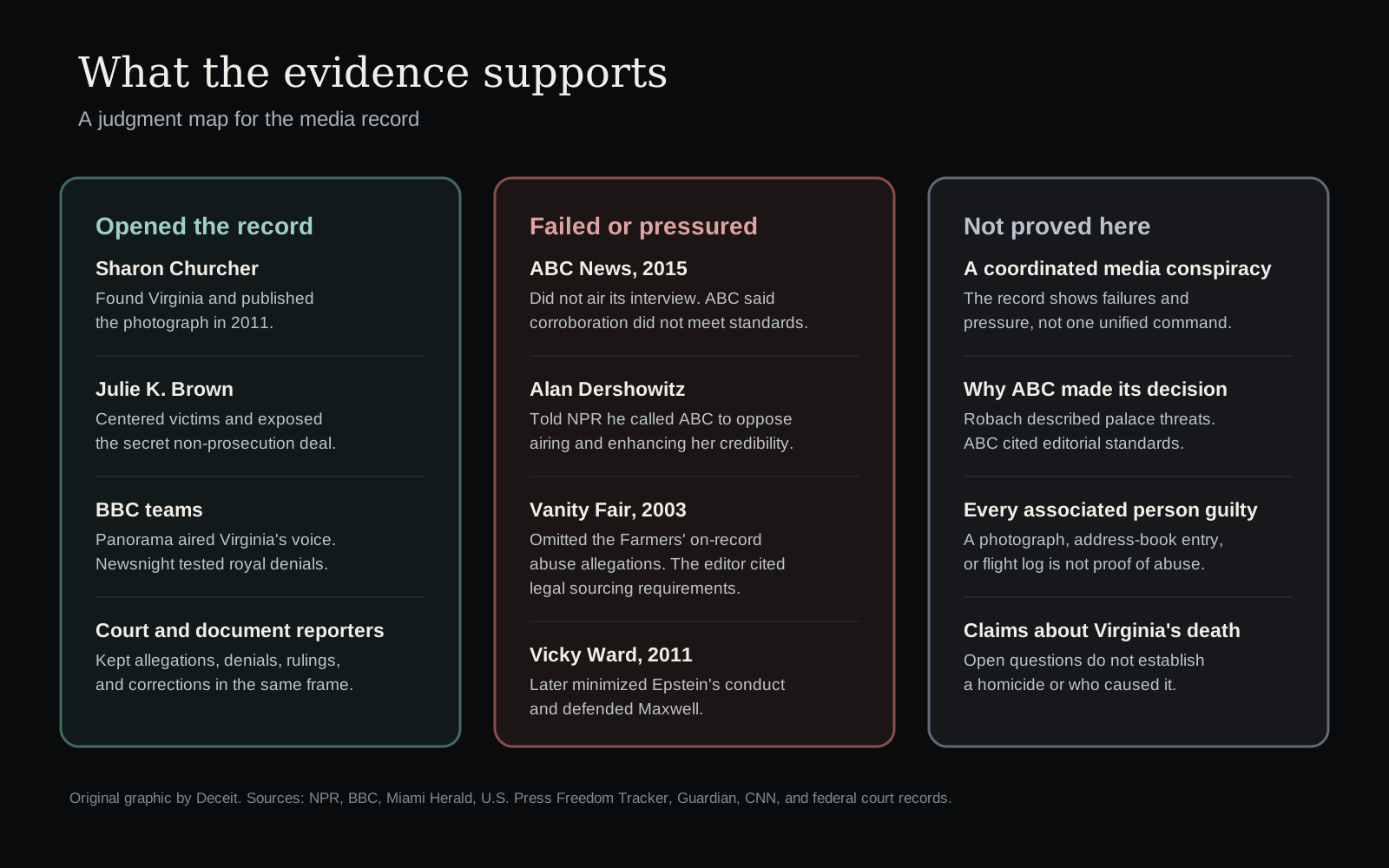
Original graphic by Deceit. Sources: NPR on ABC, NPR on Vanity Fair, the Miami Herald investigation, BBC Panorama, and the 2022 Dershowitz resolution. The classifications are my judgments. “Not proved” means the cited evidence does not establish the claim, not that every underlying question has been resolved.
What better coverage would have done
Better coverage would have identified Virginia as a person before identifying the men.
It would have said what was established, what she alleged, what defendants denied, and what remained uncertain. It would have explained trafficking instead of measuring her against a movie version of captivity. It would have disclosed payments without pretending money automatically erased evidence. It would have treated lobbying by powerful subjects as part of the story.
It would have followed the institutional chain: recruiters, employees, lawyers, prosecutors, publicists, social gatekeepers, editors, and the people who decided another question was too expensive.
It would also have corrected the record when facts changed. Virginia’s 2022 statement about Dershowitz belongs in an honest account. So does his earlier attempt to keep ABC from airing her interview. Neither fact cancels the other.
Most of all, better coverage would not have waited for a prince to make the story respectable.
Virginia had evidence before the world had appetite. She had a name before the headlines gave it back to her.
Read my personal remembrance of Virginia. Then read Nobody’s Girl and learn about SOAR.
Do not remember her only as the woman beside a prince.
Remember what she made visible.
Sources
- U.S. Press Freedom Tracker: Sharon Churcher and the 2011 reporting
- Guardian: How the photograph came to symbolize the Prince Andrew case
- Miami Herald: How Julie K. Brown investigated Epstein and his enablers
- Miami Herald: Perversion of Justice investigation
- NPR: Why Vanity Fair left out abuse allegations against Epstein
- NPR: ABC News defends its decision not to air the Giuffre interview
- BBC Panorama: The Prince and the Epstein Scandal
- BBC News: Six key moments from Prince Andrew’s Newsnight interview
- U.S. Department of Justice: Giuffre v. Maxwell court filing, Document 435-9
- CNN: Giuffre and Dershowitz end their defamation litigation
- NPR: Virginia Giuffre recounts her life in Nobody’s Girl
- Guardian review: Nobody’s Girl
- Associated Press: Timeline of the Epstein investigation
- Associated Press: Virginia Giuffre dies at 41
- ABC Australia: Police review interactions with Virginia Giuffre
