Reporting current through November 13, 2026.
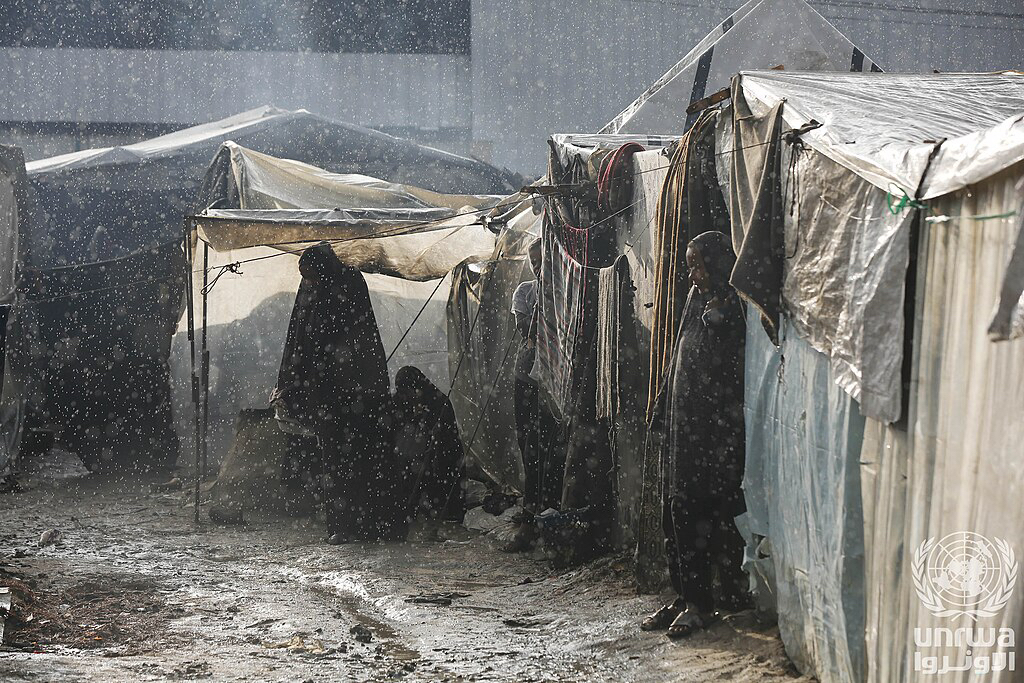
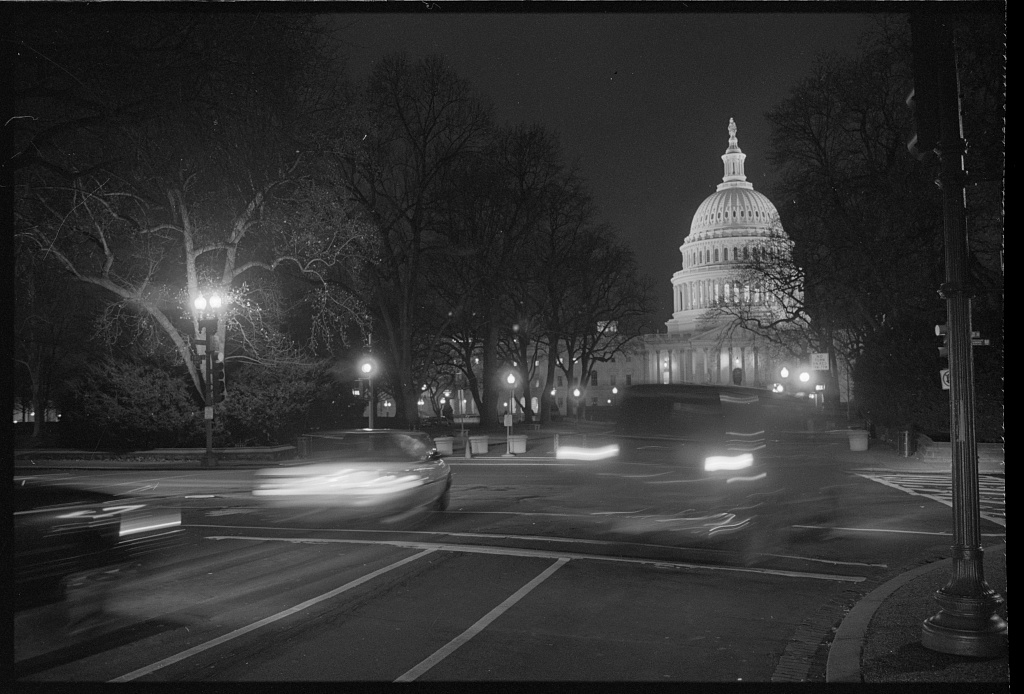
The image above pairs a 1991 photograph of the Capitol from the Library of Congress with Ashraf Amra’s photograph for UNRWA, taken in Deir el-Balah in January 2025. The Gaza photograph shows a different place and time from the November 2026 storm described below. It is shown under CC BY-SA 3.0 IGO; the displayed photographs may be resized and cropped to fit the screen.
When the rain came, Olfat Magdoub tried to sweep it away from her tent. Her mattresses were soaked. She told Reuters she was sleeping on the ground.
That was November 7 in Gaza City, four days after Americans voted for a change in Congress. A new majority will take office in January. Magdoub and the other people trying to keep their shelters dry could not wait for January to begin.
The UN reported that relief workers had reached hundreds of households after the storm, but supplies inside Gaza were nearly exhausted. On November 13, UN humanitarian leaders said more than 150,000 tents were ready for dispatch outside the territory and that Israeli restrictions continued to obstruct critical supplies. Funding shortfalls also limit the response.
Prime Minister Benjamin Netanyahu has disputed that Israel is responsible for aid delays and accused Hamas of taking aid. The Associated Press reported that he provided no evidence for that accusation. Israel’s military also denies blocking needed assistance. Associated Press
There are decisions in Washington that matter here. The United States supplies Israel’s military, and Congress can seek information, debate conditions, and vote on the terms of support. Those powers do not make every event in Gaza the result of one American vote. They do make it reasonable to ask what leaders are prepared to do when the government receiving that support continues to restrict aid and conduct a war with such devastating consequences for civilians.
The weeks before January
On November 3, voters gave Democrats a path back to power in Congress. CBS projected Democratic control of the House and Senate. The new Congress does not take office until January. Republicans remain in control during the intervening session, and Trump remains president. As lawmakers returned to Washington, Axios reported on November 9 that they faced a possible funding lapse in a little over a month, alongside a crowded legislative agenda.
The voters who chose Democratic candidates did so for different reasons. In CBS exit polling, roughly nine in ten voters said the cost of living and government corruption were major factors in their vote. Those answers do not establish a single mandate for every policy Democrats might pursue. They do show how widely people feel the pressure of daily expenses and distrust of public institutions.
On November 9, Schumer and Jeffries issued a joint statement pledging to address affordability, expand access to healthcare, oppose the war in Iran, and pursue accountability for corruption. Those are their stated priorities. The record of what they actually advance will come later.
The argument over oversight had already begun. In a letter dated November 9, White House counsel Will Scharf warned Representative Robert Garcia that threats designed to deter officials from public service, or process meant only to abuse or frighten recipients, could cross into criminality. Garcia, the leading Democrat on the House Oversight Committee, rejected the warning. The Associated Press reported that Democrats were preparing investigations into the administration, including immigration enforcement and the president’s family business interests; Trump and the White House have denied wrongdoing. Congress has the authority to investigate. Claims of wrongdoing still need evidence.
The election did not stop immigration arrests. In a report published November 11, AP described how Luis and Carlos Orta-Santoro were stopped and detained while driving back to their Alabama community college after visiting their parents. The 19-year-old brothers play soccer at the school. Their relatives told the Associated Press they had pending asylum applications and valid work permits. The Department of Homeland Security said the brothers entered legally but overstayed, and that pending asylum applications do not confer legal status. Their case, the department said, would be heard by an immigration judge.
Their college called them valued members of its community. Whatever the legal outcome, the detention took two young men away from school and placed a family in the position of waiting for a decision it cannot make. Oversight can ask how enforcement decisions are made and what happens to people in custody. Families facing medical bills also need a credible economic agenda. Democrats will have to explain which tools they intend to use for each task.
Jeffries and the vote
There is a decision before Congress now. In a November 10 letter, twelve senators asked leaders to remove three provisions from defense legislation under negotiation. The House and Senate bills each propose a U.S.-Israel defense technology initiative. A separate provision in an intelligence authorization measure would require expanded intelligence sharing with Israel and prohibit it from being suspended, reduced, or materially limited. The senators objected to locking in those commitments while Israel’s actions in Gaza and the West Bank remained matters of grave concern.
Jeffries and Schumer were among the leaders addressed. Asked on November 12, Jeffries said he had not spoken with the letter’s lead signer, Senator Chris Van Hollen, and called for changes in Gaza, the West Bank, and the U.S.-Israel assistance framework. He did not endorse removing the provisions. Van Hollen has also announced a challenge to Schumer for Senate leadership. The new majority has not yet chosen its leader.
In July, the House voted on an amendment introduced by Representative Thomas Massie, a Republican who has consistently opposed foreign aid. The measure would have eliminated $3.3 billion in assistance to Israel. It failed 104 to 314. Jeffries voted against it; 103 Democrats voted for it, 98 against, and ten voted present. CBS reported the vote and the debate inside the party.
Jeffries said the amendment was too broad. He argued that it could limit humanitarian aid, refugee resettlement, peacebuilding, embassy operations, and the American ability to confront Hamas and Hezbollah. He also called for a major reset in the U.S. relationship with Israel. Democratic Whip Katherine Clark supported the amendment while acknowledging that members could disagree in good faith. Representative Greg Casar said that, despite concerns about humanitarian funding, opposing billions in military support was the more important consideration.
Jeffries identified a real question about the amendment’s reach. He also opposed the measure as Palestinian civilians faced the consequences of an offensive supported with American arms. If the amendment threatened civilian aid, leadership could put forward an alternative that protects it while placing limits on military assistance. His call for a reset deserves a measure with terms the public can examine.
Schumer’s choices
Schumer has described the humanitarian crisis in Gaza in direct terms. In July 2025, he called on the Trump administration and Netanyahu government to increase food and other aid. He also said he had voted against resolutions disapproving arms assistance because he viewed Israeli security assistance as support for the Israeli people rather than for a particular government.
That distinction matters to Schumer’s argument. It does not answer what happens when weapons reach the government conducting the war. Security for Israeli civilians is a real need. So is protection for Palestinian civilians living under bombardment and restriction. A policy has to account for both, including what American weapons make possible.
Schumer’s position has not consisted only of opposition to restrictions. On September 29, 2026, he voted to discharge from committee a resolution requesting information on Israel’s human rights practices. The motion failed, 47 to 51. That was a procedural vote, not passage of the resolution. It is evidence that he supported seeking information; it is not proof that he supported a particular restriction on weapons.
The pattern of caution has appeared at home, too. In March 2025, Schumer supported advancing a Republican funding bill, arguing that a shutdown would give the Trump administration more room to damage federal agencies. House Democrats and others challenged the decision. A shutdown would have carried its own costs for workers and people who depend on federal services. Schumer’s judgment was a choice between harms, and critics were entitled to ask whether passing the bill surrendered a chance to constrain the administration. The Washington Post reported both his reasoning and the backlash.
The people living with the policy
On October 7, 2023, Hamas-led militants attacked southern Israel, killing about 1,200 people and taking 251 hostages, according to Associated Press reporting. The murders and abductions were atrocities.
Palestinians have also borne devastating losses in Israel’s offensive. As of November 12, Gaza’s health ministry reported more than 74,600 deaths. The Associated Press identifies the ministry as part of the Hamas-run government and notes that its figures are generally considered reliable by the international community. The ministry does not distinguish civilians from militants in its toll.
A ceasefire that began in October 2025 slowed large-scale fighting, but it did not end the killing. In its November 5 report, the UN cited Gaza health ministry figures reporting 1,593 Palestinian fatalities since the agreement, through November 2. Israeli authorities had suspended shipments from Egypt, with some exceptions, citing smuggling concerns. The UN warned that daily meal production and free distribution could fall by about 45 percent if the suspension continued. Its Gaza impact snapshot cited an assessment finding more than three-quarters of housing units damaged or destroyed as of October 2025, released in April 2026. UN impact snapshot
On November 12, an Israeli airstrike hit the surgical wing of Nasser Hospital in Khan Younis. Gaza’s health ministry said six people were killed, including general surgeon Dr. Rizk Abu Shaira and a 13-year-old patient. British surgeon Goher Rahbour told the Associated Press he had operated alongside Abu Shaira only hours earlier. The hospital’s director said surgeries and other services were suspended because of the damage.
The Israeli military said it was targeting a Hamas commander and other militants. The commander it identified was not among the dead, AP reported. The hospital director said there had been no warning before the strike; the military said it had warned about alleged military activity at the hospital on several occasions. Those accounts matter. So does the loss of a surgeon at a hospital where people already struggled to find care.
Congress did not order that strike. The executive branch controls arms decisions as well. But members of Congress can examine how American support is used and decide what conditions to pursue. They should be willing to say what evidence would change their position.
The argument that deserves an answer
Zionism is a political movement associated with Jewish national self-determination. Zionists disagree about Palestinian rights, settlements, borders, and the Israeli government. Jewish people also hold a wide range of views, including opposition to Zionism. No Jewish person owes an explanation for the conduct of the Israeli state because of their religion or ancestry.
In August 2025, Israeli Finance Minister Bezalel Smotrich announced approval for construction in the E1 area of the occupied West Bank. He said the plan would bury the idea of a Palestinian state. CBS and the Associated Press reported that final approval was still needed at the time. A year later, Human Rights Watch reported that a tender for 1,234 housing units had opened. Palestinian residents and Israeli organizations challenged the plans. According to the organizations, a court declined to halt the tender in September while the underlying petitions remained pending. They warned that development would further divide the West Bank and undermine a political resolution.
On November 3, Israeli authorities demolished roughly half the structures in the Palestinian Bedouin community of Bir al-Maskub, including homes, kitchens, and sanitation facilities, according to a joint report by Ir Amim, Bimkom, and Peace Now. The groups said about 20 people were displaced and described the demolition as part of the effort to advance settlement plans in the E1 area. The local municipality said it had requested the demolition.
Smotrich stated his aim openly. Treating a Palestinian state as something to bury is a political choice, not an obligation of Jewish identity. Palestinians are entitled to freedom and self-determination, and the policies that foreclose those rights deserve opposition.
Political organizations should be named for what they do. In 2024, the United Democracy Project, a super PAC affiliated with the American Israel Public Affairs Committee, spent almost $10 million supporting the opponent of Representative Jamaal Bowman and more than $5 million campaigning against Representative Cori Bush, according to KQED. Both Democrats had criticized Israel’s conduct, and both lost their primaries. KQED reported the spending. That record warrants scrutiny of political influence; it does not prove that the money alone decided either race or that a particular legislator’s vote was bought.
What comes next
Some progressive activists have challenged Jeffries and Schumer for being too close to donors, too supportive of Israel, and too cautious in opposing Trump. The Washington Post reported their effort on November 10. On November 13, protesters interrupted Jeffries at a Democratic conference, demanding an arms embargo against Israel and a Green New Deal. His party has won a major electoral victory. Its argument over what that victory requires is still underway.
The next Congress can investigate the administration, hold hearings on arms transfers, and write legislation. Trump will still have a veto. Voters deserve to see which measures Democratic leaders bring forward, what they concede, and where they draw a line.
Jeffries has described a future in which Israelis and Palestinians both have security and self-determination. That future requires more than a statement of sympathy. The provisions now before Congress give him and Schumer a specific question to answer: will they let these commitments advance as written, or will they use the power they have to demand different terms?
Olfat Magdoub should not have to become a symbol to be worth that answer. She needed a dry place to sleep when Reuters met her. People facing another winter in damaged homes and temporary shelters need decisions that take their lives as seriously as the language used to describe them.