
The song
For six years, Rachel Accurso sang “Wheels on the Bus” to toddlers. The song does what all her work does: it invites a child to make a sound and waits for them to answer. The wheels go round and round. The child hums, then sings, then laughs. A voice reaches out. A voice comes back.
In March 2026, she sang it to a 5-year-old boy who could not speak.
His name was Gael. He is nonverbal and was being assessed for autism. He and his parents had been detained at a routine immigration check-in in El Paso and sent to the Dilley Immigration Processing Center in South Texas. NBC News reported that his severe constipation had spiraled. His mother said he had not defecated in nine days. His stomach was visibly distended. He gagged when he tried to eat. He had begun hitting himself, a behavior his parents had never seen.
Accurso slipped into character on the video call. She held up a toy. She talked to him about trains. Then she sang.
“Treating a child this way is a crime,” she told NBC News. “It’s neglect and child abuse.”
The song is designed to reach a child who will not speak. That night it was sung to a child the state had silenced. Same song. Different room.
The spelling bee
On the same calls, Accurso spoke to a 9-year-old named Deiver Henao Jimenez. He told her the food made his stomach hurt. The lights never turned off. He missed his friends. Most of all, he wanted to leave detention and go to the state spelling bee.
Before his family was detained, Deiver had won his school spelling bee in Las Cruces, New Mexico. He placed third at regionals. He had earned a spot at the state competition.
The woman on the screen wore a pink headband. She leaned toward the camera.
“You have a real gift for spelling,” she said. “You’re so smart.”
Then her smile faltered.
“We’re trying to get a child out of a jail to do a spelling bee,” she told NBC News. “I just never thought those words would go together.”
Her name is Rachel Accurso. The world knows her as Ms. Rachel.
The origin
The work started because her own son would not talk.
Rachel Anne Griffin grew up in Maine, studied music, earned a master’s degree in music education from NYU, and taught preschool. She later completed a second master’s degree in early childhood education. In 2016 she married Aron Accurso, a Broadway music director and composer. Their son Thomas had a speech delay.
“My son inspired the whole thing,” she said in a profile of her early work. She wanted a slow, interactive show that used the methods his speech therapist used to help him talk.
She launched the YouTube channel in 2019. She and Aron built it with educators and developmental experts. The videos used songs, repetition, hand movements, and sign language. The signature look was a pink T-shirt, denim overalls, and a pink headband.
The classroom grew to more than 15 million YouTube subscribers, billions of views, a Netflix audience, and a shelf of children’s books. She became an ambassador for Save the Children US. In May 2024, personalized Cameo videos raised $50,000 in a few hours for children in Gaza, Sudan, and Ukraine.
She did not set out to be a moral witness. She set out to help her son talk.
The faith and the lineage
The profile is incomplete without the faith she names as the source of the work.
In a July 2026 interview with the National Catholic Reporter, Accurso said she and Aron were raised in the Unitarian tradition. She described prayer as a daily practice and her work as grounded in the teachings of Jesus. “I’m here to help kids, and I am here to serve God,” she said.
She also grew up on Mister Rogers’ Neighborhood and names Fred Rogers as her hero. The Washington Post described the connection: neither educator talks down to children.
In 1969, Rogers testified before the United States Senate to defend public television funding. He spoke softly. He quoted a child. He made the room see what the budget line meant.
Fifty-seven years later, another children’s television host went to Washington carrying letters and drawings from children held at Dilley. The Washington Post followed her through the Capitol as she delivered their words to congressional offices.
The lineage is not a compliment. It is a job description.
Her philosophy fits in one sentence: “I see all children as precious and equal.”
At the Glamour Women of the Year Awards, she wore a gown embroidered with artwork sent by children in Gaza. She named the children who contributed. Then she quoted Rama, a girl who had lost both sisters: “My sisters are not numbers. They are moons. They are like the stars—they shine and sparkle.”
The room stood.
The cost
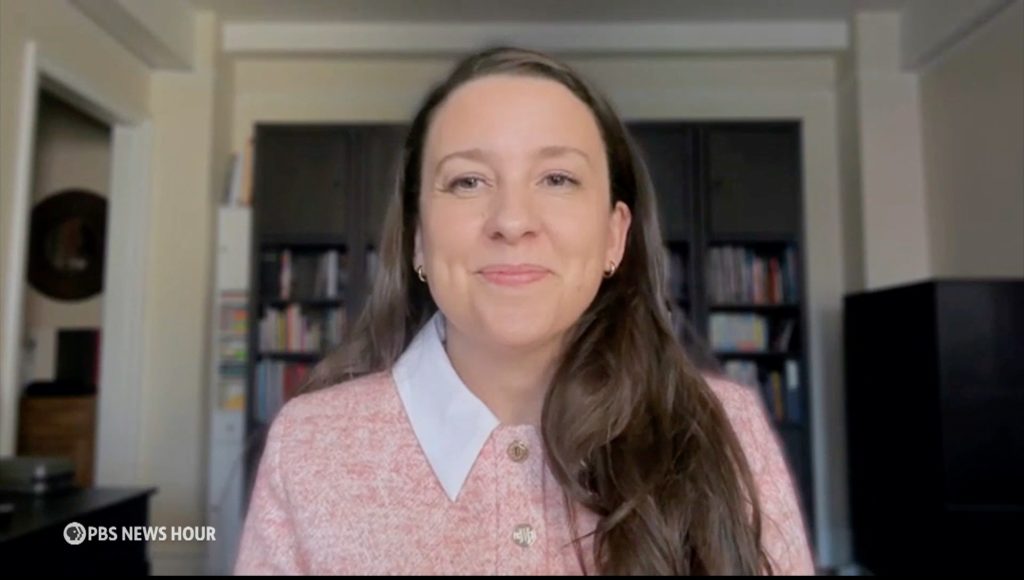
In April 2025, StopAntisemitism labeled Accurso an antisemite and asked the attorney general to investigate whether she was acting as a paid foreign agent. PBS NewsHour put the allegation to her directly. The public accusation identified no payment, contract, or evidence of coordination.
The label traveled. Parents warned other parents. Search results filled with accusations. Supporters answered with their own slogans. The result was not one conversation. It was a filing system. Her name had been placed under a charge that arrived before the evidence.
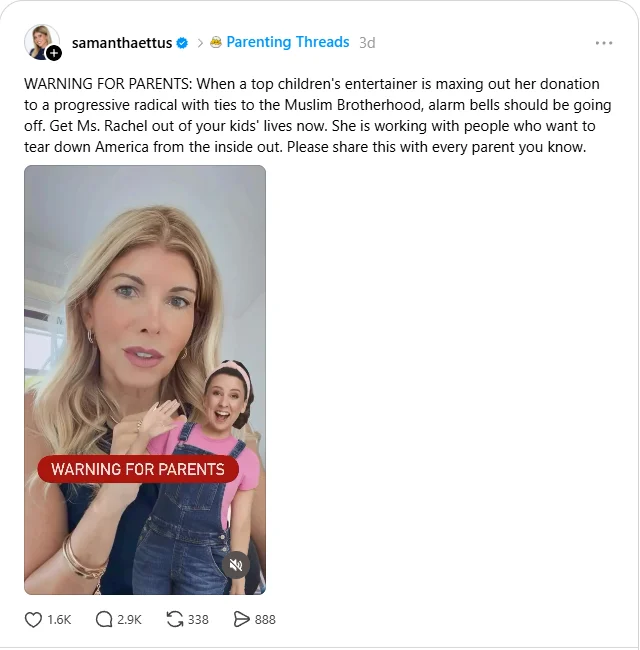
By December 2025, threats had forced her to hire security. In an Instagram statement reported by Middle East Eye, she described her son overhearing a conversation about her safety and crying because he feared something would happen to her.
The criticism did not all have the same evidentiary status. In January 2026, Accurso mistakenly liked an antisemitic Instagram comment while trying to hide or delete it. She apologized. She said she opposed antisemitism and had Jewish relatives and friends. Jewish News documented the comment and her response.
The mistake warranted reporting and correction. It did not establish that she endorsed the comment, received foreign funding, or coordinated with a political organization. Good-faith criticism and an allegation that cannot be disproved are not the same thing.
She told NBC she initially hesitated to speak about ICE detention because the Gaza advocacy had already brought threats against her family. She worried it would inflame the situation.
Then she called Deiver. Then she called Gael. Then she went to Washington.
The record
The shorter timeline is enough:
- 2019: She launches a channel to help her son talk.
- 2024: Her fundraiser supports children in Gaza, Sudan, and Ukraine.
- April to August 2025: The foreign-agent allegation appears. She answers it in interviews and keeps advocating.
- November to December 2025: She carries children’s artwork onto a national stage. Threats force her family to hire security.
- March to June 2026: She speaks with families detained at Dilley, asks for the facility to close, and carries children’s letters to Congress.
The sequence does not prove that every critic acted together. It establishes something narrower. Each attempt to reduce her to a label was followed by a more specific act of witness.
“I see all children as precious and equal” became “We’re trying to get a child out of a jail to do a spelling bee.”
What she is
She is not a geopolitical analyst. The cited record does not make her a foreign agent. She is an educator with master’s degrees in music education and early childhood education who made a show for toddlers because her son could not talk.
She sang “Wheels on the Bus” to a nonverbal 5-year-old in a detention center while his mother described his distended stomach.
She wore a dress embroidered with drawings from children in a war zone and quoted a girl who had lost her sisters.
She said “I am political” and meant: I will not pretend that a child in a cage is outside my concern because the child is not mine, not here, not the right religion, not the right color.
The song is not a weapon. It is an invitation. Six years of teaching children to talk, and one night a song for a child the state had silenced. The wheels go round and round. It does not stop.
How to support her
- Start here: send a note of support. Jews for Racial & Economic Justice collects messages through its “We’ve Got Your Back” campaign.
- Support the children at the center of the work. Accurso is an ambassador for Save the Children US, which received the proceeds from her Cameo fundraiser.
- Use direct channels. Her books and official site support the work without turning the controversy into a product.
This is a companion to The Antisemite Label Is Being Weaponized Against a Children’s Educator, which documents the funding network and policy architecture behind the attack. This piece is about the woman. That piece is about the machine.