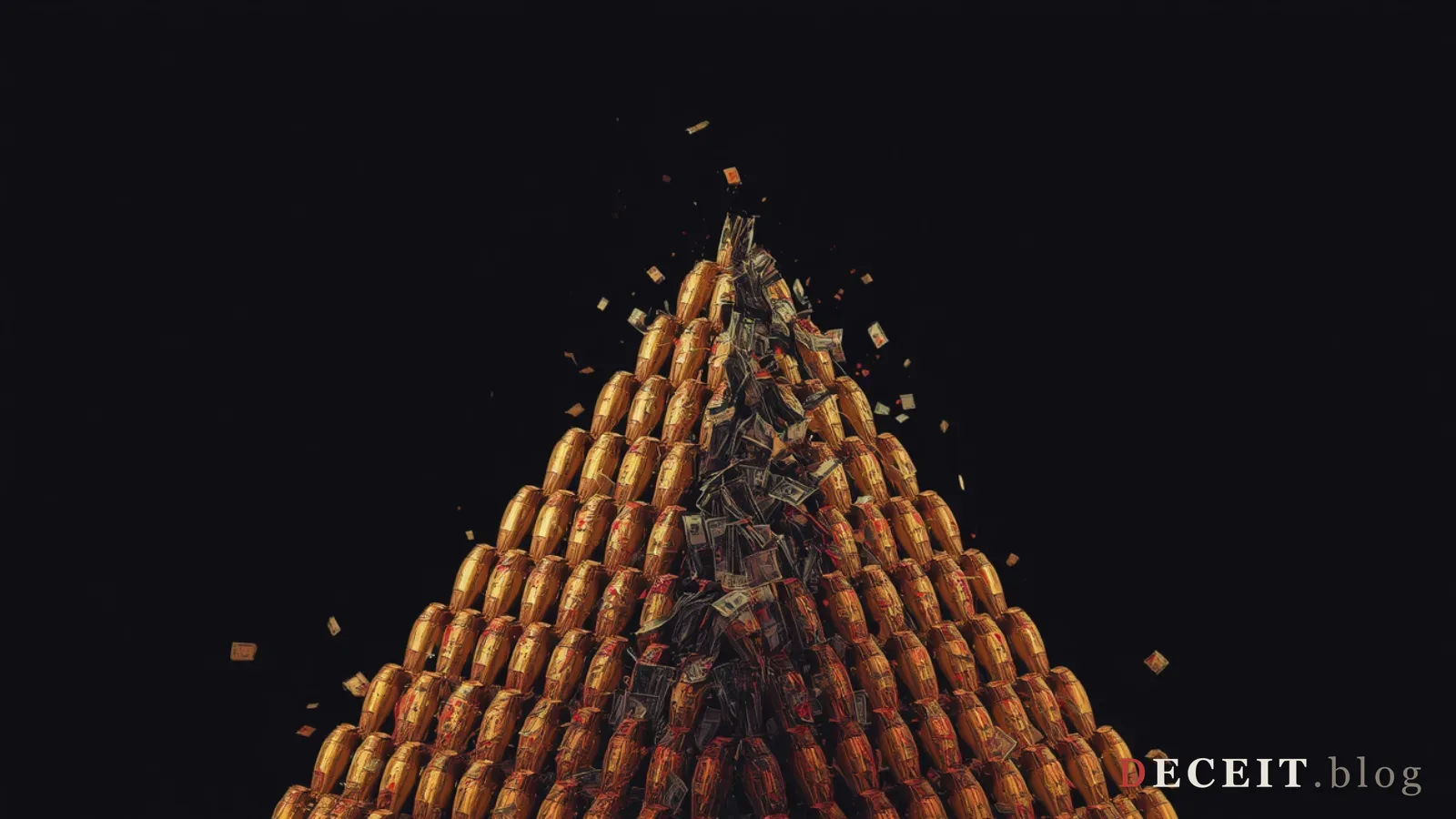

MonaVie’s chief science officer helped develop the product. He is on record calling it “expensive flavored water.” He said the health claims made about it were “purely hypothetical, unsubstantiated and, quite frankly, bogus,” and that he did not actually know how much açai the juice contained. The Salt Lake Tribune reported this, from an internal memo and deposition testimony that surfaced in litigation, while MonaVie was still selling the product as a cure for cancer, arthritis, and joint pain, through a distributor network of hundreds of thousands of people, most of whom lost money doing it.
That is not the aftermath. That is the design.
The founder had done this exact thing before
Dallin Larsen founded MonaVie in 2005. Before that, he was vice president of sales at Dynamic Essentials, a Florida company that sold a fruit juice called Royal Tongan Limu. Larsen claimed he grew the company’s revenue 300%. In 2002, the FDA warned Dynamic Essentials that claims on its website that the juice could “treat various diseases such as cancer, arthritis, and attention deficit disorder” were illegal. Dynamic Essentials shut down soon after. In 2003, the FDA watched the company voluntarily destroy 90,000 bottles of the juice.
Two years later, Larsen started a new juice company, with new fruit, and the same claims.
MonaVie launched in January 2005, blending açai and other fruit concentrates into a beverage. By mid-2008, according to Newsweek’s profile of the company, MonaVie said it was selling a million bottles a week, had signed its millionth “unsalaried sales person,” and had passed $1 billion in cumulative sales, a figure Newsweek noted the company, as a private organization, was not required to substantiate. Larsen took the stage at a company rally in front of 4,000 people, flanked by a Ferrari, a Maserati, a Bentley, a Rolls-Royce, and a Lamborghini, swigging from a bottle of the product as he spoke. Two of the company’s top distributors told Newsweek they had built a 30,000-person “tree” beneath them and were earning more than $1 million each a year, up to 20% of every sale their recruits made. Newsweek’s own reporting noted that his sales team could get him in hot water with the Feds, and Larsen himself said that policing distributors making illegal health claims was “next to impossible… like herding cats”, this from a company running an 18-person compliance department against a million-person sales force. Company executives repeatedly acknowledged the false claims were happening. They kept selling the product anyway.
The math distributors were never shown
MLM compensation plans are complicated by design. MonaVie’s income disclosures, when they surfaced, were not.
The Hartford Courant, reporting on MonaVie’s own 2008 Income Disclosure Statement, found that 45% of distributors earned an annualized average check of less than $1,600. Another 37% took home about $2,000 a year. Roughly 2% earned more than $29,000. Seven distributors, out of 80,000, took home more than $3 million, fewer than 0.01% of the entire sales force.
A 2011 Salt Lake Tribune analysis of MonaVie’s own distributor income disclosures found that 98.5% of distributors who earned any commission at all averaged just $129 a month. Counting every signed distributor, not just the ones who earned something, 86% took home no bonus whatsoever. Using MonaVie’s 2010 statement, the paper found the top 1% of distributors averaged $52,992 a month; the other 99% averaged $841 a month. Only 34 people, out of roughly 92,000 active distributors, made a million dollars or more in 2009, 0.05% of the sales force. Ninety-five percent of commission-earning distributors, everyone outside the top 5%, averaged $200 a month between them; the bottom 90% earned even less than that. The Tribune found the same shape at competing juice MLMs XanGo and Tahitian Noni, which is the actual tell: this was not a MonaVie problem. It was the business model working as designed.
One of those distributors was Donna Pierce of Corona, California, whose bankruptcy filing became part of the public record: over 11 months in 2009 and 2010, she earned an average of $209 a month in commissions against $520 a month in expenses, a loss of roughly $311 every single month, $3,418 total. She was not unusual. She was the median.
A 2008 Forbes investigation by Emily Lambert and Klaus Kneale grouped MonaVie among the “juice selling schemes” it was covering, and found a second pyramid layered directly on top of the first. MonaVie had partnered with Orrin Woodward, a former Amway distributor who ran a separate motivational-materials company called TEAM, which sold MonaVie recruits $258 packages of audio programs, seminars, and coaching, a second business selling the tools to sell the first one. If a distributor could not earn back that $258 selling $39 bottles of juice, Forbes wrote, there was another way: sell the $258 motivational package to someone else, who could sell it to someone else again. “Everybody gets rich,” the article’s framing went. “Everybody, that is, except the last round of buyers.” Forbes put a number on how often that actually worked: a mere 1% of TEAM’s own members ever made any money from their involvement with the company. MonaVie gave Woodward a $3 million loan he did not have to repay if he hit his recruiting targets, according to a lawsuit Amway later filed.
The lawsuits nobody making the pitch mentioned
Oprah Winfrey and Dr. Mehmet Oz sued MonaVie and 39 other açaí companies in 2009, after distributors circulated fabricated quotes putting endorsements in Oz’s and Winfrey’s mouths for products neither of them had used or approved.
In 2014, a class action filed in the US District Court for the Southern District of Florida went further than the usual “the health claims aren’t proven” complaint. It alleged MonaVie’s juices contained arsenic and lead, and that the company never disclosed this to the people drinking it daily on the promise of “increased energy and improved joint health.”
Separately, Quixtar (Amway’s sister company) sued MonaVie in 2008, accusing it of poaching top Amway distributors and violating their non-compete agreements. Orrin Woodward and his wife were later found liable in arbitration for soliciting other Amway distributors to defect to MonaVie. The award: $12,736,659. Two more distributor couples caught in the same arbitration were ordered to pay $9,578,756 and $3,533,230. These are not symbolic damages. They are what a court decided the poaching was actually worth.
MonaVie’s own distributors sued the company too, and won. In 2015, an arbitrator awarded former distributor Joseph Licciardi $1.2 million, ruling that MonaVie breached its contract by not giving him the chance to cure the alleged violation before terminating him, as its own agreement required (MonaVie was appealing the award at the time).
The collapse
MonaVie defaulted on the $182 million loan that had been securing the company’s assets since 2010 - the loan was due by June 30, 2014, and by May 2015, the Salt Lake Tribune reported the company that once claimed more than $1 billion in annual sales was foreclosed on for $15 million, bought by Jeunesse Global, a rival multi-level-marketing company, for less than a tenth of the debt it had once secured.
The sale almost didn’t happen cleanly, either. A federal judge issued a temporary restraining order to briefly halt the Jeunesse takeover, after Bankers Trust, the trustee overseeing MonaVie’s employee stock ownership plan, argued the foreclosure would wipe out the retirement stock held by MonaVie’s own staff. Distributors were not the only people MonaVie’s collapse cost. Its employees’ retirement accounts were on the line too, held in a company whose product its own chief scientist would not defend.
The pattern, named
None of this required a secret. Every piece of it was published, litigated, or admitted by the company itself, while the pitch to new distributors kept running underneath the coverage. That is what makes an MLM different from an ordinary company with a bad product: the bad math is not a flaw in the system. Recruiting is the system. A tiny number of early, well-connected distributors profit from the labor and losses of everyone recruited beneath them, and the product exists to make the recruitment pitch legal.
MonaVie’s chief science officer said the quiet part out loud once, to a reporter, and nothing about the business changed. That is the tell. In a company built on the product, that admission would have been a crisis. In a company built on the recruitment structure, it was just something a scientist said.
Verdict: The juice was real. The health claims were not evidence-based, by the company’s own science officer’s account. Fewer than 1% of distributors made meaningful money, by the company’s own disclosures. The founder had run this playbook before, and the FDA had already stopped it once. The lawsuits were real, the settlements were real, and the $182-million-to-$15-million collapse is a matter of federal court record. The story sold to each new distributor (that they were different, that they would be the exception) was the only part that was not.