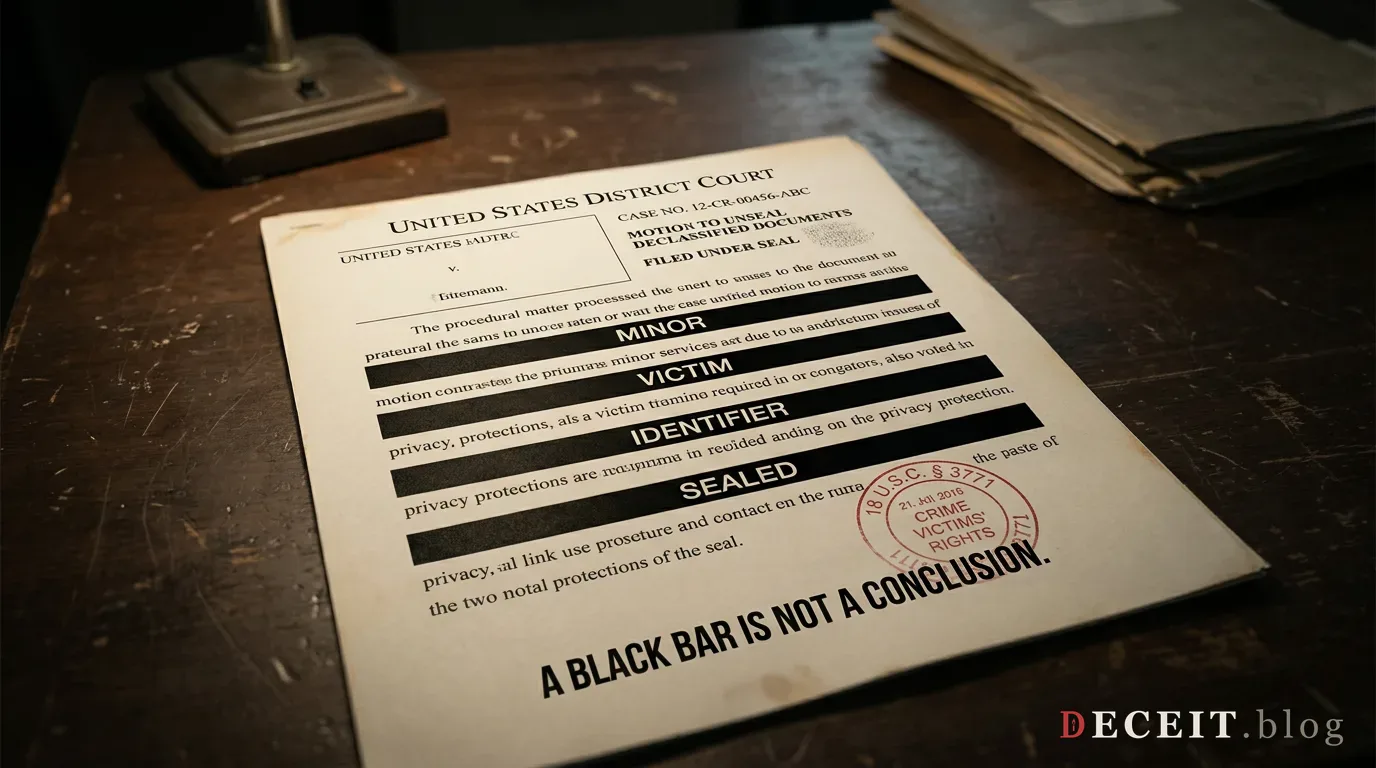
Some information is removed to protect minors, victims, personal identifiers, sealed material, and the integrity of proceedings.
Last reviewed: 2026-07-13
Illustration by Deceit. Not documentary evidence.Image.
Redaction is part of the public record system
Federal privacy rules require filers to redact specified personal identifiers. The official courts guidance includes Social Security and taxpayer numbers, dates of birth beyond the year, financial account numbers beyond the final four digits, and the names of known minors beyond initials. Criminal filings also restrict home address detail. [9]
Courts may also permit sealed filings or order additional protection. A released document can therefore be authentic and still omit information by design.
Victim dignity is a legal interest
The Crime Victims’ Rights Act includes a right to be treated with fairness and respect for dignity and privacy. [10] In a record involving sexual exploitation of minors, privacy is not a decorative concern. It can be part of the legal duty owed to survivors.
Publishing a protected identity for the sake of completeness can reproduce harm without adding a valid finding.
A black bar is not a conclusion
The visible redaction does not tell the reader why material was withheld. It may protect an identifier, reflect a sealing order, preserve an investigative interest, or remove information outside the release scope. The governing order or release note is needed before assigning a reason.
The archive labels the bar as redacted and cites the source. If the legal basis is not stated in the available record, the basis remains unknown.
Source Register
Primary record used
In re Wild, No. 19-13843, en banc opinion✓link verifiedU.S. Court of Appeals for the Eleventh Circuit, 2021-04-15. Appellate decision addressing the Crime Victims’ Rights Act and the absence of a filed federal charge.Read the primary source (mirrored copy)Public domain — U.S. Court of Appeals for the Eleventh Circuit (17 U.S.C. §105). Mirrored 2026-08-21 against link rot.
Crime Victims’ Rights Act, 18 U.S.C. § 3771✓link verifiedU.S. Code via Legal Information Institute, current through 2026. Statutory text, including rights to confer, notice, fairness, dignity, and privacy.