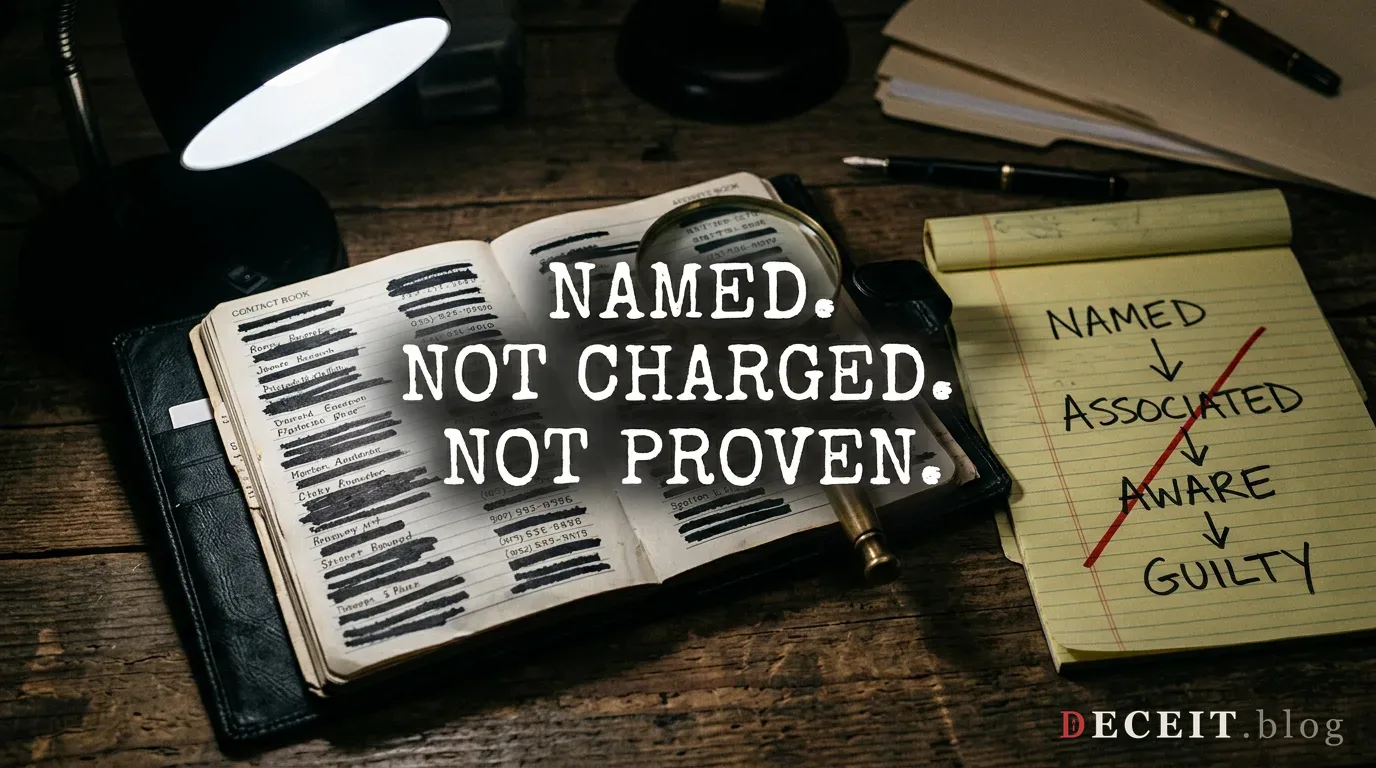

A ledger page of redaction bars with a magnifying loupe resting over a single unredacted row

Epstein Public Record / Evidence Brief

Names Are Not Findings

A name in a contact book, flight log, deposition, or filing proves only what that particular record can establish.

Last reviewed: 2026-07-13

The same ledger revealed as a study in association. Behind the neat rows, a name proves only what that record can establish. Contact is not knowledge. Proximity is not culpability. The association fallacy exposed.A clean, official ledger page. Neat rows of names and entries, a magnifying loupe, formal record-keeping. Documented, indexed, thorough.
Illustration by Deceit. Not documentary evidence.
Image.

Documents answer narrow questions

A contact entry can show that contact information was recorded. A flight log can document a recorded passenger entry for a journey. A deposition can show that a witness gave particular testimony. None of those records, standing alone, proves knowledge of another person’s crimes or participation in them.

Charging documents answer a different question. They state what prosecutors alleged against a named defendant. Even then, the government warns that an indictment is an accusation until adjudicated. [4] [5]

Association and liability are not synonyms

Public discussion often compresses several steps into one: named, associated, aware, involved, guilty. The record does not permit those substitutions. Each step needs its own evidence and legal context.

Maxwell’s case demonstrates the difference. Her legal status rests on charges tested at trial and a jury verdict, not on the fact that her name appeared near Epstein’s. [6] [7]

Use the minimum supported statement

When a record identifies someone but provides no adjudicated finding about that person, this archive says exactly where the name appears and what the source says. It does not turn proximity into culpability.

Privacy rules also mean that public filings can be intentionally incomplete. Federal rules require redaction of specified identifiers, including the names of known minors. [9] An absent or shortened name may reflect lawful protection, not evidence of concealment.

Source Register

Primary record used

  1. Jeffrey Epstein charged in Manhattan federal courtlink verifiedU.S. Attorney’s Office, Southern District of New York, 2019-07-08. Official description of the 2019 indictment. The release expressly labels the allegations as accusations.
  2. United States v. Jeffrey Epstein indictmentlink verifiedU.S. District Court, Southern District of New York via DOJ, 2019-07-02. The charging document in United States v. Epstein, 19 Cr. 490.Read the primary source (mirrored copy)Public domain — U.S. District Court, Southern District of New York, via the U.S. Department of Justice (17 U.S.C. §105). Mirrored 2026-08-22 against link rot.
  3. Statement on the verdict in United States v. Ghislaine Maxwelllink verifiedU.S. Attorney’s Office, Southern District of New York, 2021-12-29. Official confirmation of the jury verdict.
  4. United States v. Ghislaine Maxwell case informationlink verifiedU.S. Attorney’s Office, Southern District of New York, 2022-06-24. Official case page with charging and victim information.
  5. Privacy requirements for federal electronic court filingslink verifiedAdministrative Office of the U.S. Courts, accessed 2026-07-13. Official explanation of mandatory redactions and filer responsibility.