To the Christians who’ve watched Mark Driscoll get his stage back, and to everyone else who’s ever trusted a man because of the size of the room he could fill,
Start with what’s true. He can preach. People who sat under him at Mars Hill describe a real season, real growth, a church that reached men nobody else was reaching. Hold onto that, because nothing below erases it, and this letter isn’t asking you to pretend it didn’t happen.
Here’s the narrower thing it’s asking. His own pastors investigated him twice: not his enemies, the men who worked beside him. The second time, they disqualified him in writing and offered him a road back. He said no, and built his next church with no one left in the room able to ask him again. That part isn’t in dispute anywhere, including from him. So before you decide what you think about anything else you’ve read about him, sit with the part that was never contested at all.
Two different readers get to the end of this letter. Christians hearing some of it for the first time, and Christians who already knew and made a call anyway. Both get spoken to directly, later on. If you’re not Christian, or you have no stake in this particular church, the split is still worth watching for. It’s what it looks like when an institution keeps grading a man on the size of the crowd he can still draw instead of on what the people who actually worked for him found.
The first time, it didn’t work
In May 2013, a Mars Hill pastor named Dave Kraft filed formal charges against Driscoll under the church’s own rules: domineering, verbally violent, arrogant, quick-tempered, a pattern going back years. Seven more people came forward to back him up. Mars Hill’s own accountability board heard it all and ruled the charges non-disqualifying. Cleared. The first time his own church tried to hold him to account, the body he’d appointed to do it waved him through.
It didn’t hold. A book scandal broke a few months later. Mars Hill had quietly paid a marketing firm $25,000 to bulk-buy over 11,000 copies of Driscoll’s own book, engineering it onto the New York Times bestseller list. Called it a “marketing investment” until the backlash made them retract it. A plagiarism accusation followed, then more of it turned up in his other books, then his publisher quietly shelved what he had coming next.
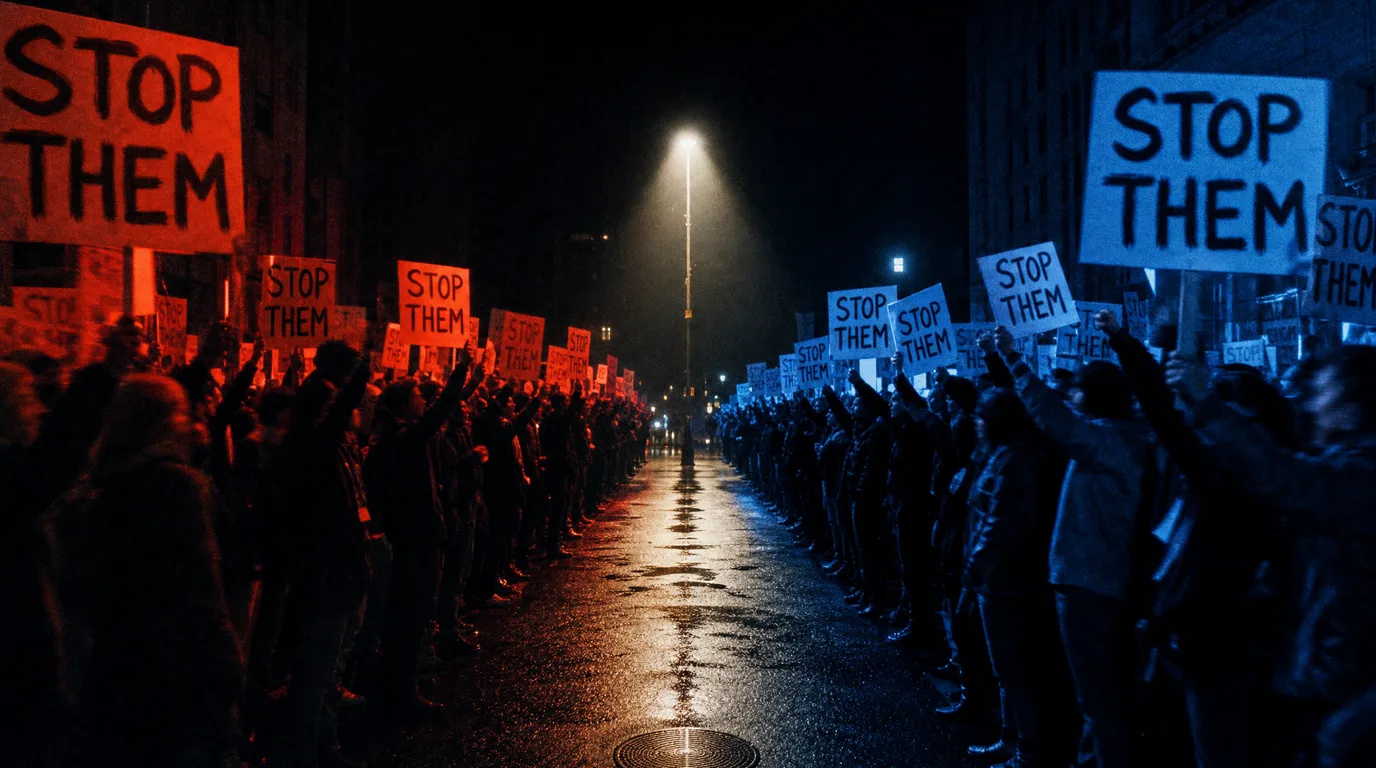
By early August 2014, around sixty-five people were picketing outside the church’s Bellevue campus, carrying signs that read WE ARE NOT ANONYMOUS and QUESTION MARK. A former Mars Hill deacon named Rob Smith had organized it. Driscoll was on vacation when it happened.
By August 2014, twenty-one former Mars Hill pastors, his own staff and not outside critics, filed a second, much bigger set of charges, describing the same pattern reaching back to 2010. This time it stuck. The board disqualified him as an elder and offered him a real path back: supervised, accountable, defined. He turned it down. Resigned instead, citing concerns for his health and safety, and announced he’d start over in Phoenix. Four days earlier, Acts 29, the church-planting network he’d co-founded and led as president until stepping back in 2012, had already voted him out, citing what they called a pattern of ungodly and disqualifying behavior. Within three months Mars Hill itself was gone. Fourteen thousand people across five states lost their church.
The exit was a production
That should be the whole story. It isn’t, because one of those twenty-one elders kept his notes.
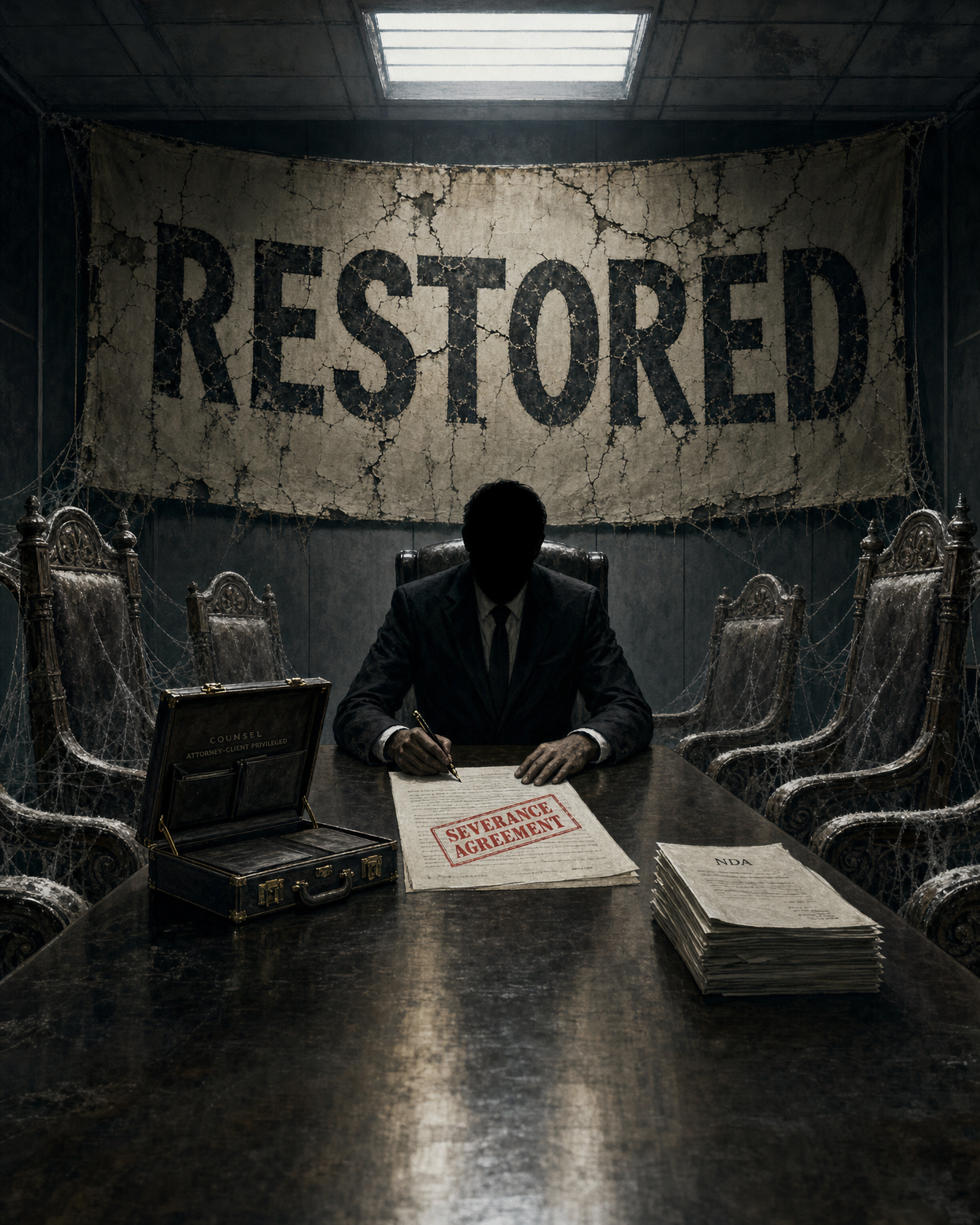
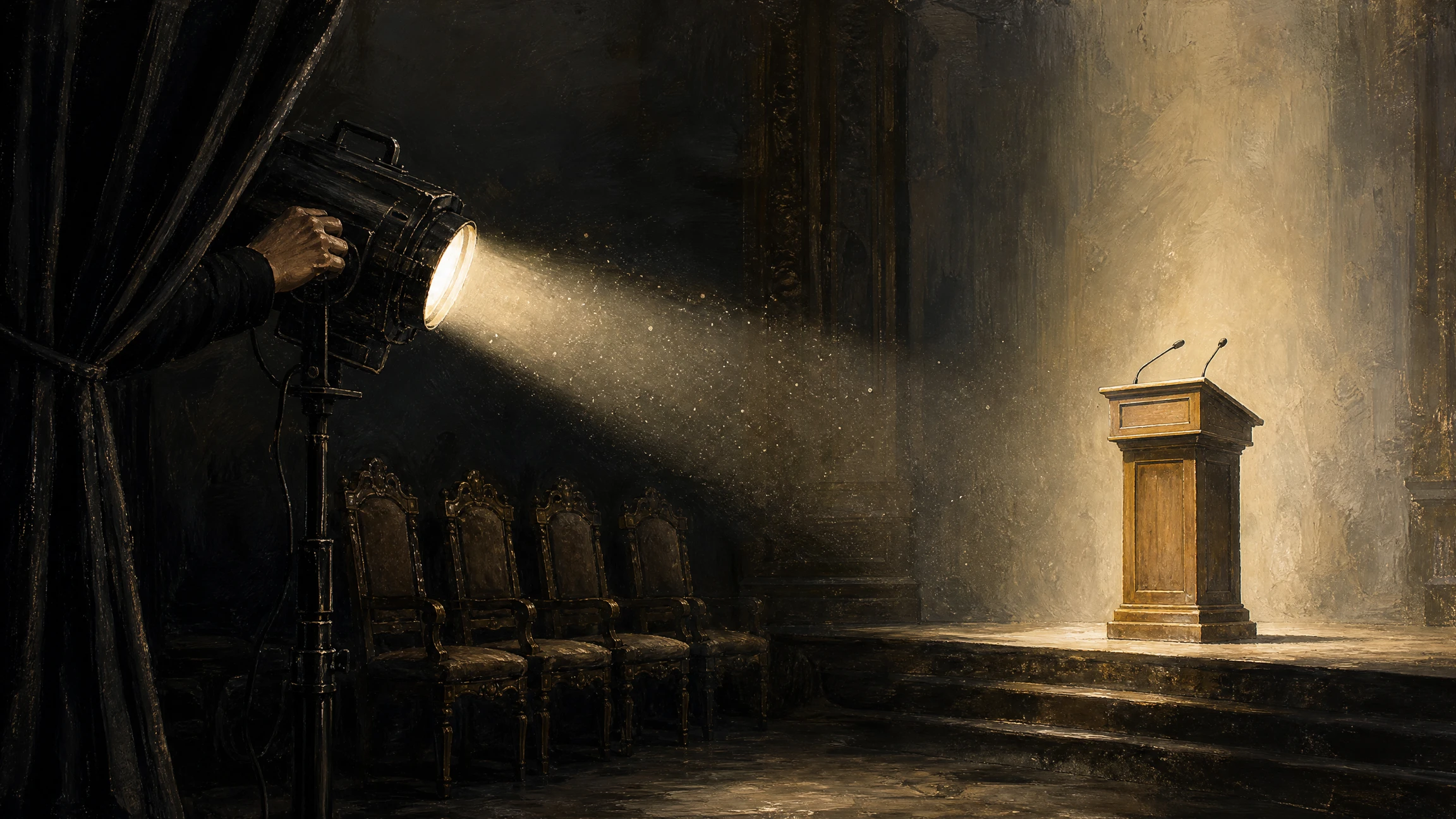 AI-generated editorial illustration by Deceit. Not documentary evidence.
Sutton Turner ran Mars Hill’s finances and sat on its board through the collapse. In January 2022, he published roughly thirty pages of what he wrote down in real time during the 2014 investigation. Turner’s account describes more than a bad temper. It describes Driscoll coordinating with a crisis-communications consultant and a religion-news outlet to shape the story before it broke, threatening legal action against elders who might talk about the investigation, and inventing, according to Turner, at least one claim to the board outright: that transgenderism was actively splitting other churches.
If Turner’s notes hold up, the resignation wasn’t a man stepping down because his elders found him unfit. It was a man managing the exit before they could say so publicly.
He built the next one with nobody to ask
Driscoll opened Trinity Church in Scottsdale in February 2016. By 2021, reporters checking its structure found what should have been the headline on its own: no elder board. A handful of other pastors with no independent power to check him. A small outside corporate board that included people who didn’t even attend the church. Chad Freese, who ran Trinity’s security team before he left too, has said on the record that this wasn’t an accident: Driscoll built it this way on purpose, specifically so the thing that happened at Mars Hill couldn’t happen to him again.
Read that twice. The lesson he took from being disqualified wasn’t repentance. It was architecture.
In July 2021, forty-one former Mars Hill elders and pastors, some of the same twenty-one joined by twenty more, put their names on a public letter. They called him unrepentant. Unfit to pastor. They asked him to step down from any spiritual authority and submit to real reconciliation. Forty-one men who used to work for him, on the record, asking him to stop.
He has never answered them. Not a rebuttal, not a defense, not one word. Silence isn’t proof of anything by itself. But it’s not nothing, either, when the people asking are the ones who know him best.
This year, the same tools, a new name on the door
In June 2026, Caleb Glennie, who’d run Trinity’s men’s ministry and helped operate its security team, resigned to start his own church. Driscoll’s response ran the same play as 2014: a mass email accusing Glennie of stealing member data and lying for months, an Acts 20 line about “fierce wolves … among you,” a threat of a lawsuit. Glennie didn’t answer reporters’ calls. The Roys Report, checking Trinity’s books at the time, confirmed the church still has zero elders, and that four of its eleven ministers had left within the year.
Separately, a former teenage congregant named Vince Manuele published a book alleging that Trinity made interns, some of them minors, sign agreements not to tell their own parents what happened inside the church, and released what he says is a piece of that document. Trinity has called that specific claim categorically false, on the record, and that denial belongs here alongside the accusation. Manuele has also alleged a private investigator followed his family afterward and that Driscoll’s own finances don’t add up; those claims are his alone so far, tied to a book he’s selling, and nobody has independently nailed them down. Said plainly, so you know exactly what’s solid and what isn’t yet.
The rebrand found a bigger stage than the last one
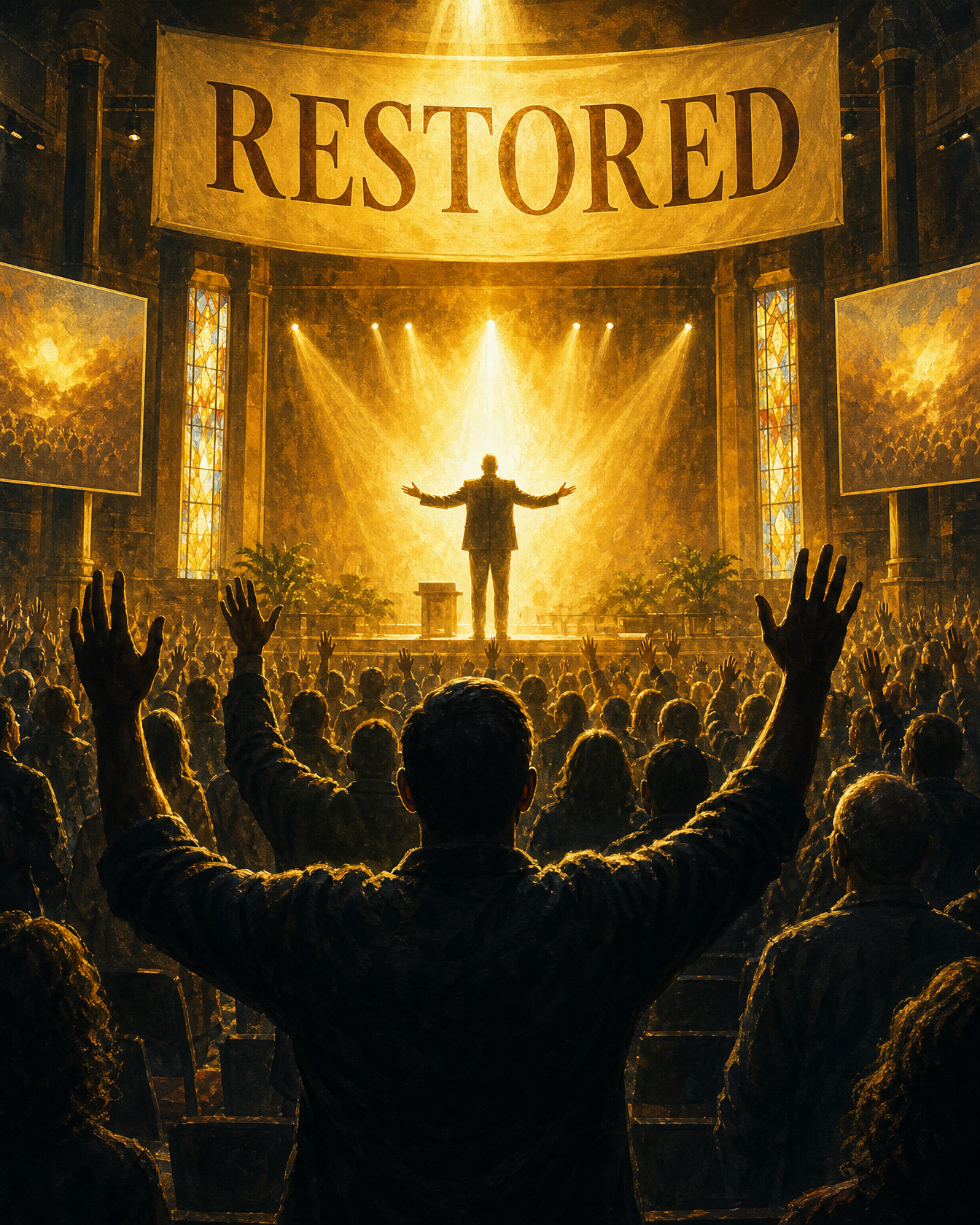
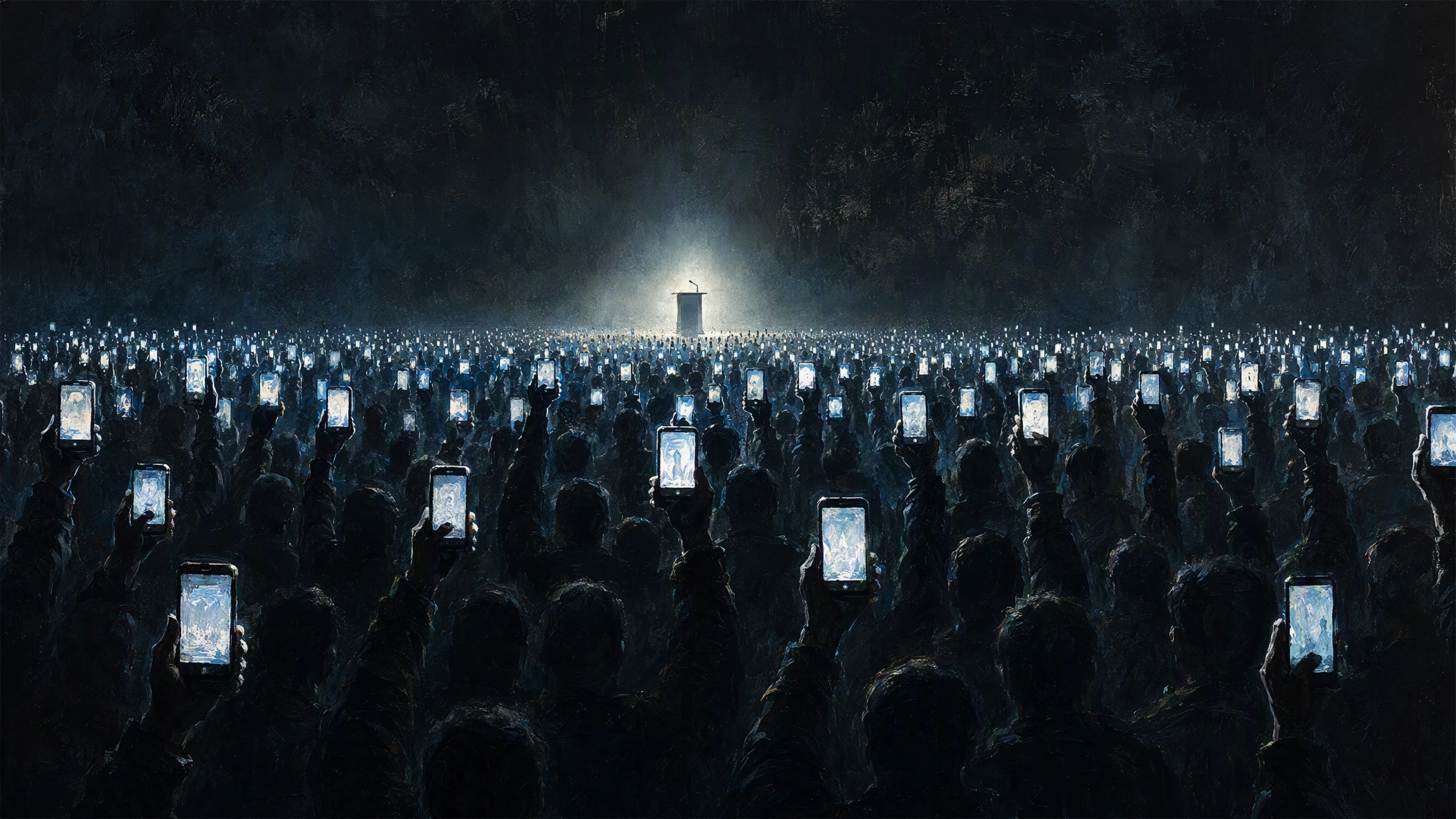 AI-generated editorial illustration by Deceit. Symbolic scene; no real platform, app, or person depicted.
While Trinity was losing ministers and threatening lawsuits, Driscoll was building the biggest audience he’s had since Mars Hill, just somewhere else. Charlie Kirk put him on The Charlie Kirk Show in August 2023 and introduced him as one of the best, most important Bible teachers in the world. Turning Point USA’s faith wing packaged his sermons into ready-made kits for clergy and handed them to a generation of young conservatives who’d never heard of Mars Hill. In October 2024 he sat in on Trump’s National Faith Advisory Board, Kirk in the room with him.
Kirk was assassinated in September 2025. In the months after, Driscoll’s online audience, tracked by the Christianity Today media analyst Mike Cosper, climbed into the hundreds of thousands. He runs an Instagram account with more than a million followers now, and the persona drawing them in is a new one: part culture-war commentator, part political pastor, built for video in a way the Seattle-era Driscoll wasn’t.
This isn’t the first time he’s used an anonymous or amplified voice to control how he’s seen. In 2000, posting on Mars Hill’s own church forum under the pseudonym William Wallace II, he attacked critics and, by his own account in a later memoir, “sinned and cussed a lot” doing it. When the old posts resurfaced in 2014, he apologized to his congregation and admitted he’d been wrong to talk to people the way he did. He also announced that same year he was done with social media for good. He wasn’t. He came back with a bigger account and an audience that mostly wasn’t born yet the first time around.
If you didn’t know
Some of you are reading this from inside a church that still books him, or a coaching program still selling his methods, or just a fondness for a preacher who mattered to you once. You didn’t have this file. Now you do.
You don’t owe him your continued trust just because you gave it once. Ask your own leadership why he’s still a name on your calendar. Ask whether anyone called the twenty-one before they extended the invitation. If the answer is no, that’s your answer too. Sincere trust, once informed, becomes a choice. And a church that keeps choosing him after this is choosing something other than the twenty-one men who paid to tell the truth about him.
If you knew
Some of you already had this file and platformed him anyway.
John Lindell has hosted Driscoll at James River Church since 2014, the same year Driscoll’s own elders disqualified him. Sutton Turner has said directly, on the record, that Lindell never called the men who worked for Driscoll before handing him a microphone. In 2024, it was Lindell’s own stage where Driscoll walked out mid-event to call a performer’s act demonic. Lindell cut him off in front of the crowd, telling him wrong time, and that he was done. Lindell told reporters afterward that Driscoll was out of line and should have raised it with him privately, not from the pulpit. Whatever Lindell thought of the outburst, the invitation itself was proof the platform was still open, ten years after the men who worked for Driscoll told him why it shouldn’t be.
Costi Hinn, a pastor who has publicly criticized Driscoll’s methods, says Driscoll now sells a leadership-coaching package built around what Hinn calls “the Driscoll contract”: a severance deal Hinn describes as structured so a pastor can be fired for almost nothing except adultery, insulated from every ground that actually ended Driscoll’s first career.
This part isn’t about them specifically. It’s for anyone reading this who already had some version of this file and booked the stage anyway, bought the coaching package anyway, took the invitation anyway. If that’s you: you didn’t miss the record. Somewhere you weighed it against a full room, a speaking fee, a coaching contract. And the record lost. That’s not a mistake that needs correcting gently. That’s a choice. You’re allowed to make a different one starting now. Stop making the first one.
What’s actually being asked
Not that you hate him. Hate is cheap and it asks nothing of you. What’s being asked is smaller and harder: check whether the people around you already knew, and if they did, stop pretending that not-knowing is still available to you too.
Who investigated him, and what did they find? Did he ever answer them, anywhere, in fourteen years? Why would a man rebuilding after a disqualification for unaccountable leadership choose, on purpose, a church with no one left who could investigate him again? And the men who keep handing him a stage: did they call the twenty-one, or did they just check the size of the crowd he still draws?
The twenty-one didn’t do this for revenge. They did it because somebody had to be able to say, on the record, with their names attached, that it happened. That’s the part worth protecting. Not him. Them.
— Someone who called the twenty-one
Sources and scope
None of this is original reporting, and nobody named here, Driscoll, Trinity, anyone else, was contacted before it ran. One thing making the rounds right now isn’t in it: the Sutton Turner baptism clip. Its trail runs out at a repost of a repost, no original source behind it, so it stayed out. Trinity’s NDA denial sits next to the claim it’s denying, not tucked away somewhere it’s easy to miss. Anything resting on one person’s word says so, plainly, where it happens, not just here at the bottom. Sources are linked as they’re used, and listed again below.