Peter Thiel’s private Dialog network was exposed by a security failure. The leak doesn’t prove a secret cult: it shows how the wealthy turn secrecy, scoring, and apocalyptic language into a system for deciding who gets to shape the future.
The Guardian reported that a private retreat was scheduled to begin near Dublin on August 12. The guest list was not public. The conversations were meant to stay off the record. The people expected to attend came from the parts of society that can move money, build surveillance systems, direct military policy, regulate artificial intelligence, or write the laws that govern all three.
The event is called Dialog.
Its leaked agenda includes “Bring Back Nuclear,” “Navigating WWIII,” “Battlefield Technologies,” “Democracy Under Surveillance,” “How’s Your Sex Life?” and, most remarkably, “Build-a-Cult.” WIRED reported that the retreat registration records named 222 people. A separate directory exposed in the code of Dialog’s website contained 113 names, although a name in that directory does not establish whether someone was a member, a guest, a speaker, or a one-time attendee.
That last distinction matters. It is the difference between reporting and mythology.
The facts are already strange enough.
The room was real
Dialog was co-founded in 2006 by Peter Thiel and investor Auren Hoffman. It is invitation-only, runs private retreats, and uses non-attribution rules to keep discussions out of the public record. Axios described it in 2025 as a secretive network for CEOs, elected officials, and intellectuals, and also reported that Dialog was planning a physical campus in the D.C. area. The Guardian independently verified that a participant list had been exposed in the website’s source code. Axios and The Guardian both reported the group’s long-running secrecy and its invitation-only retreats.
The exposure itself was a front-end failure: WIRED reported that a directory of attendee information was embedded in the client-side code of Dialog’s registration site, where anyone who inspected the page could retrieve it. For a group built around secrecy, the mistake was a structural one.
The records put public officials and private executives in the same social infrastructure. WIRED reported names including Treasury Secretary Scott Bessent, Army Secretary Dan Driscoll, Senator Ted Cruz, a NATO supreme allied commander (whom WIRED identified by name), and Palantir co-founder Joe Lonsdale. The Guardian’s separate review of the exposed directory added Elon Musk, Jared Kushner, and a range of foreign officials, investors, journalists, academics, and religious figures.
That does not mean every person named in the records is a Dialog member. It does not prove that the people listed acted together. It does not turn a dinner, a speaking engagement, or an invitation into a conspiracy. The Guardian reported that several people named in the directory publicly described themselves as former guests or one-time participants, including Maryland Governor Wes Moore and Senator Cory Booker. The records show proximity. They do not, by themselves, show agreement.
What they do show is a private room where institutions that are normally supposed to check one another can overlap. A data broker can sit beside a policymaker. A defense contractor can sit beside an official who oversees military procurement. A technology investor can sit beside the people writing rules for technology.
There may be perfectly legitimate reasons to hold a private conversation. There is also a democratic cost when the public learns about that conversation only because someone found the guest list in the page source.
The agenda is not a confession
“Build-a-Cult” is a fact. The title appears in the leaked program. WIRED reported that the session was moderated by the founder of the Christian networking service Pray.com. The Guardian also reported the session and linked it to the same leaked agenda.
What we do not know is what the session meant.
There is no public transcript. There is no verified record showing that the workshop took place. There is no evidence that Dialog’s members were asked to join a religious movement, submit to a leader, surrender their money, cut off their families, or obey a doctrine.
A provocative session title can be a joke, a branding exercise, a discussion about political organizing, or a serious workshop. It can also be all of those things at once. The title is evidence of what the organizers wanted to put on the menu, not proof of what happened in the room.
This is the point where the original viral framing goes wrong. It treats the most theatrical words in the leak as if they were minutes from a meeting to overthrow democracy. They are not. A program is a program. A roster is a roster. The work is to understand the structure without inventing the missing pages.
So, is Dialog a cult?
No one can responsibly say that as a factual conclusion from the public record.
The American Psychological Association’s dictionary defines a cult as a religious or quasi-religious group associated with unusual beliefs, seclusion, and authoritarian structure. Academic researchers have also warned that “cult” has no single agreed definition and is often used as a pejorative label. A 2025 Cambridge University Press Element, Abuse in New Religious Movements, describes the more useful question as whether a group uses manipulation, undue influence, coercive control, deception, or abuse to control members.
Using that standard, the available reporting establishes some features that can look cultic:
- Dialog is secretive and socially insulated from public scrutiny.
- It uses rituals of belonging: invitations, assigned seating, non-attribution, private retreats, and a language of exceptional people.
- Its internal files reportedly rank participants by wealth and fame, assign “value-add” scores, influence seating and introductions, and help set prices.
- Its agenda puts existential subjects such as war, artificial intelligence, surveillance, and the future of democracy beside sex, matchmaking, and a session called “Build-a-Cult.”
That is an architecture of elite belonging. It is not yet evidence of a cult in the high-control sense.
The public record does not establish a single charismatic leader whose authority is absolute. It does not establish forced isolation, compulsory belief, punishment for leaving, communal living, or psychological control over the whole of a member’s life. It does not establish that Dialog has a shared theology. Its own materials, as reported by WIRED and The Guardian, describe the organization as nonpartisan and non-ideological, although that description is a claim made by the organization, not an independent finding. The named roster leans heavily toward one party’s officials and allies.
The cleanest description is therefore narrower: Dialog is a private elite network with cult-themed programming and a status system that rewards proximity to power. Calling it a cult as fact outruns the evidence. Calling the group’s machinery cult-like is an interpretation, and a defensible one, if the limits are stated.
The deeper cult is status
The most revealing leak may not be the phrase “Build-a-Cult.” It may be the grading system.
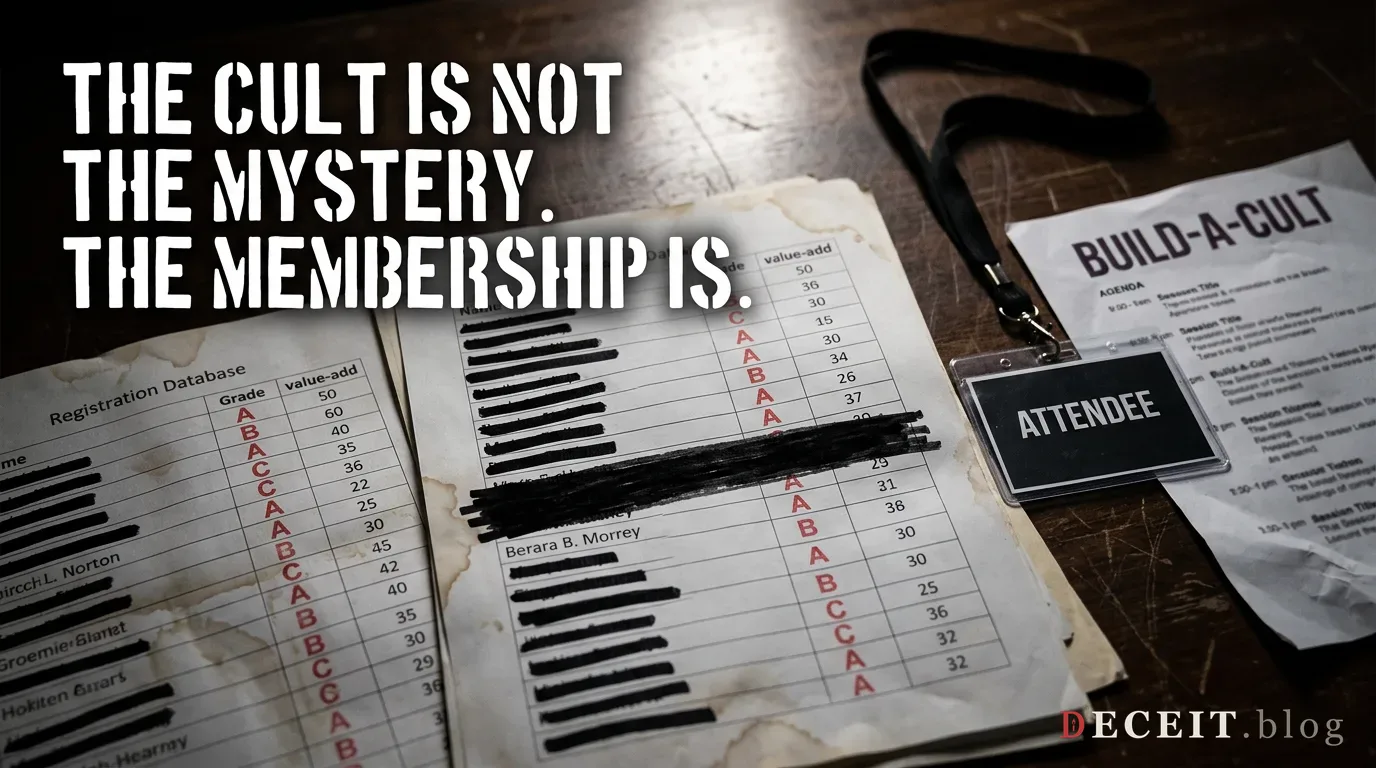
According to WIRED, Dialog assigns attendees grades of A, B, or C, and the hierarchy runs backward from what the letters suggest: the rare “C” grade, given to only about one in seven, is reserved for the most famous and influential people, while “A” is the bottom tier, assigned mostly to older, established members the group’s own staff rate as less notable. Staff also assign a “value-add” score, track culture fit, and can disinvite people whose value falls below the group’s threshold. The grades reportedly affect seating, introductions, and what people pay to attend. The Guardian summarized the same reporting, including the claim that lower-ranked attendees were more likely to pay full price.
This is not a cult ritual. It is something more familiar: a private market for status.
But status markets can become belief systems. They teach members that the room is valuable because the people in it are valuable, and that a person’s value can be measured by wealth, fame, access, or the ability to confer access on someone else. The network does not have to tell its members that they are a chosen people. The ranking system can communicate the idea for it.
The dating and networking tools sharpen the point. WIRED reported that Dialog’s forms asked whether participants were looking for love and that a separate site offered “meaningful connections for exceptional people.” Staff also maintained suggested matches and “do-not-pair” lists.
The reporting does not establish trafficking, and this article does not allege it. The factual story is both less lurid and more consequential: a private organization built a database that linked status, politics, professional history, personal information, and romantic availability. It then failed to protect that database.
The Thiel layer
Dialog is not identical to Peter Thiel. But Thiel’s public record helps explain why the leak feels so charged.
In a 2009 essay published by Cato Unbound, Thiel wrote that he no longer believed freedom and democracy were compatible. He argued that libertarians should look for ways to escape politics through technology, cyberspace, outer space, and seasteading. He described the future as a “deadly race” between politics and technology, with freedom as the prize. The original essay is here.
In 2025, The Washington Post reported on leaked audio from a four-part private lecture series in which Thiel connected Christianity, technology, regulation, and the Antichrist. The Post said a digital-forensics expert who reviewed a sample of the audio found it probably authentic. The Associated Press later reported on Thiel’s Roman lecture series and the controversy around Catholic institutions distancing themselves from the event.
These are Thiel’s views. They are not proof that every Dialog attendee shares them. They are not proof that Dialog is a religious organization. They are relevant because they show how a powerful investor can frame politics as a struggle between technological freedom and an apocalyptic threat, then build private networks around people who can turn that framing into policy, capital, or infrastructure.
That is an inference, not a leaked confession. The evidence supports the relationship between the ideas and the network. It does not support the claim that a secret council has agreed on a single plan for the world.
The actual danger is unaccountable coordination
The public does not need a cult to have a problem.
It is enough that senior officials, technology executives, military leaders, data brokers, financiers, religious entrepreneurs, and media figures can gather privately, sort themselves by status, trade introductions, discuss surveillance and war, and leave no public record of who said what.
It is enough that Dialog’s leaked records exposed sensitive personal information, including contact details, political leanings, emergency contacts, and login tokens. WIRED later reported that the Pentagon was examining the exposure because records included information about national-security personnel. The security failure is not evidence of a grand political plot. It is evidence that a group built around secrecy did not secure its own secrets.
It is enough that a private network can shape relationships among people who hold public power without being subject to the transparency rules applied to public institutions. Off-the-record discussion may make candor easier. It can also make accountability impossible.
The central question is not whether Dialog is secretly worshipping Peter Thiel. The central question is whether a society should accept private rooms where powerful people can decide which problems matter, which technologies deserve freedom, which officials deserve access, and which outsiders never get to hear the conversation.
This is not an argument for treating every private conference as a conspiracy. It is an argument for treating private power as a public fact.
What we know, and what we do not
We know that Dialog exists, that Thiel and Hoffman co-founded it in 2006, that it has held invitation-only off-the-record retreats, and that a website exposure revealed a directory and separate retreat records. We know the leaked agenda included “Build-a-Cult,” “Navigating WWIII,” and sessions about nuclear power, battlefield technology, surveillance, sex, and artificial intelligence. We know WIRED reported an internal grading system and matchmaking tools. We know Thiel has publicly argued for escaping politics through technology and has recently spoken in apocalyptic religious language.
We do not know that Dialog is a cult. We do not know that every person in the leaked records is a member. We do not know whether the Dublin retreat occurred, what the “Build-a-Cult” session meant, or whether it produced anything beyond conversation. We do not know that the group has a unified political program, or that its attendees coordinated illegal acts.
The difference between those two lists is the difference between investigation and mythmaking.
The leak opened a door. Behind it was not a supernatural order, a doomsday bunker, or a proven master plan. It was something more ordinary and, in its own way, more dangerous: a real network of powerful people, protected by privacy, organized by status, drawn toward big claims about technology and collapse, and capable of making decisions that affect everyone else without inviting everyone else into the room.
The cult is not the mystery.
The membership is.